
Whether you are operating a high-traffic security checkpoint or scanning a historical site for relics, knowing how to use metal detector equipment correctly is the cornerstone of efficiency. Mastering these devices requires more than just turning them on; it demands a deep understanding of electromagnetic frequencies, ground interference, and the nuanced settings. In this comprehensive guide, we will break down the essential modes and operational techniques required to transform you into a professional operator.
Modes of metal detector
Before stepping into the field or onto the security floor, an operator must understand the internal logic of their device. Regardless of whether you are utilizing a walk-through metal detector, a handheld scanner, the core settings-Discrimination, Sensitivity, and Detection Mode-function as the “three pillars” of discovery.
Adjusting these correctly is the first step in learning how to use metal detector technology to its full potential.
1. Discrimination
Discrimination is perhaps the most vital feature for any professional. This setting allows the detector to distinguish between different types of metal based on their conductivity and magnetic properties.
In Security: Discrimination is used to “ignore” common personal items such as brass buttons or small zippers while remaining alert for high-density threats like stainless steel knives or firearms.
By adjusting the discrimination circuit, the machine analyzes the “phase shift” of the returning signal. If the signal matches the profile of a rejected metal, the device remains silent. Mastering this mode is essential for saving time and reducing “operator fatigue” caused by investigating too many false positives.
2. Sensitivity and frequency
Sensitivity: Sensitivity dictates the minimum signal threshold required for the detector to trigger an alert. While it is tempting to always set the sensitivity to its maximum level, doing so in areas with high “electromagnetic interference” (EMI)-such as near power lines or cellular towers-will result in a constant chatter of false alarm.
The professional rule of thumb is to increase sensitivity until the machine becomes unstable, then back it off slightly until the audio threshold remains steady. This “sweet spot” ensures you are getting the maximum depth possible without the interference that masks real targets.
Frequency: Frequency determines the “flavor” or type of energy sent into the ground. Low frequencies (e.g., 3-5 kHz) feature long wavelengths that penetrate deep into the earth and are ideal for locating large, high-conductivity ferrous targets. Conversely, high frequencies (e.g., 18-60 kHz) are optimized for small, low-conductivity items like thin gold jewelry or tiny metal fragments.
Choosing the right frequency is essential because a high-frequency setting may be overly sensitive to “ground noise” from mineralized soil, whereas a low frequency might miss small, non-ferrous contraband entirely.
When mastering how to use metal detector settings in challenging environments, operators can “tune out” the environment using the Frequency setting, while “tuning in” the target’s depth using the Sensitivity control. This ensures you are getting the maximum sensitivity possible without the interference that masks real targets.
3. Detection mode
Most modern detectors come with pre-set modes designed for specific scenarios. Understanding these is a shortcut to professional results:
- All-metal mode: This provides sensitivity but offers no discrimination. It is used when you want to find every metallic object in an area.
- Pinpoint mode: Found mainly in handheld units, this mode narrows the search field to a tight, non-motion signal. This allows the operator to find the exact location of a target.
- Target-specific modes: Many ProScan Global devices include specialized modes like “Jewelry,” “Coins,” or “Security High-Sensitivity,” which pre-configure the discrimination and frequency levels to target specific metallic signatures.
How to use metal detector
Successfully operating a detection system is a multi-stage process. At ProScan Global, we emphasize that the “detecting” part of the job actually begins long before you receive your first alert. To master how to use metal detector technology, one must be meticulous in both preparation and execution.
1. Preparation for detecting
- Structural inspection: Begin by checking the shaft and the search coil connection. Ensure the cable is wrapped snugly around the shaft-if the cable is loose, it can move during a sweep, creating “ghost signals” as the coil detects its own internal wiring.
- Power and calibration: Turn the unit on away from large metallic objects. For a walk-through metal detector, this involves a “self-test” to ensure all zones are firing correctly.
- Test targets: Always carry a “test piece”-a known metal object like a coin or a specific security test wand. Pass it through the gate to verify that the current sensitivity and discrimination settings are responding as expected.
2. Start detecting
Once the machine is calibrated, the actual search begins. The technique varies significantly depending on the device type, but the goal is always “total coverage.”
- For ground search: Keep the coil parallel to the ground at all times. Many beginners make the mistake of “pendulum swinging,” where the coil lifts up at the end of each sweep. This causes you to lose depth at the edges of your path. Overlap each sweep by 50% to ensure no small targets are missed in the gaps.
- For handheld scanners: When learning how to use metal detector wands for person-screening, use a systematic “figure-eight” or “S-pattern.” Start from the shoulders, move down the torso, and pay special attention to the ankles and waistline where items are most commonly concealed. Maintain a distance of about 1 to 2 inches from the body for maximum sensitivity without physical contact.
- For walk-through gates: The operator’s role is to monitor the zone indicators. If the alarm sounds, the operator must direct the individual to remove metallic items and pass through again, or follow up with a handheld unit to “pinpoint” the exact location of the alert.
> Read more: How does a metal detector work?
ProScan Global OEM Security Systems
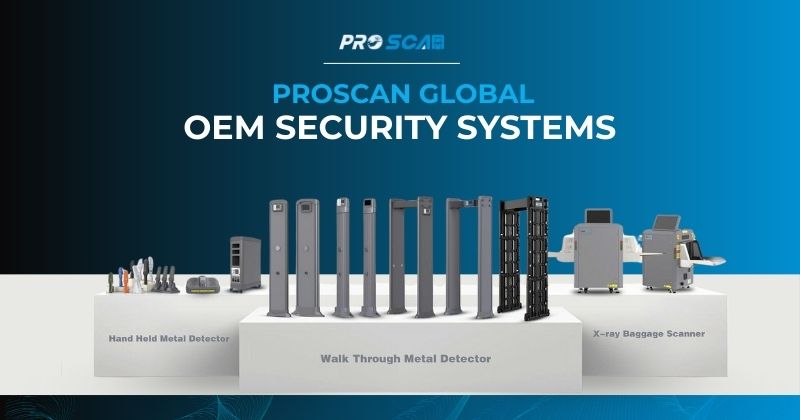
As a leader in the industry, ProScan Global doesn’t just teach you how to use metal detector equipment for the first time; we design and manufacture it. Our OEM (Original Equipment Manufacturer) and ODM (Original Design Manufacturer) services allow businesses and government agencies to deploy customized security hardware that meets specific regional or industrial standards.
By choosing ProScan Global OEM systems, you are getting hardware that is engineered for the “pro user.” Our systems are designed with intuitive interfaces that make the learning curve of how to use basic metal detector technology much shorter for security staff, ensuring that your facility is protected by the most advanced logic and sensing technology available today.
Our product lineup is comprehensive, covering every security vertical:
- Handheld metal detectors: Built for durability and high-frequency sensitivity, our handheld units are a global standard in aviation and correctional facilities. To align with your brand identity or specific operational needs, we offer full customization of colors, logos, and alert sounds. Furthermore, our advanced models feature an integrated visual thermal gradient scale; as the device nears a metallic object, the thermal indicator rises, providing security personnel with precise, intuitive proximity feedback.
- Walk-through metal detectors: We provide industry-leading multi-zone gates designed for high-traffic environments. Our systems are highly scalable, offering customizable configurations up to 93 detection zones and 72 pre-defined security scenarios. For a holistic security approach, these units can be seamlessly integrated with CCTV systems, allowing for real-time surveillance and synchronized data capture.
- Shoe scanners: A specialized solution for high-security zones, our shoe scanners detect metallic threats hidden in footwear without requiring the person to remove their shoes, drastically increasing the speed of security lines.
Mastering the technical nuances of how to use metal detector systems is the definitive bridge between basic operation and professional-grade security. The effectiveness of a security perimeter-relies on the synergy between advanced hardware and operator expertise. From the precise calibration of discrimination and sensitivity to the disciplined execution of a systematic sweep, every detail contributes to a seamless and secure environment.

One Response