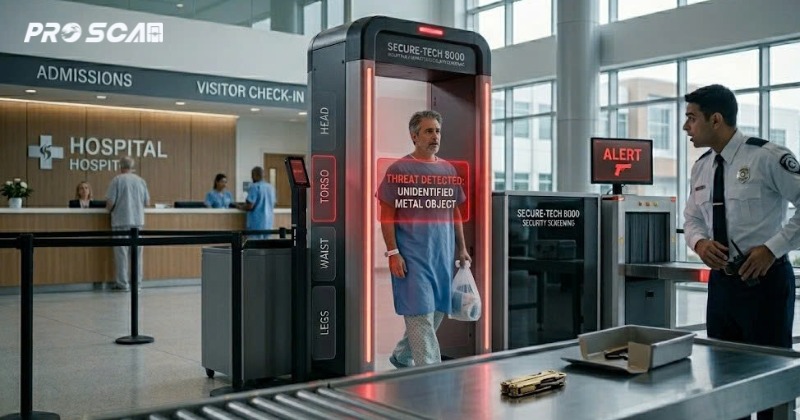
Starting December 2025, hospitals in Nova Scotia began deploying AI-powered weapons screening systems at key entry points, including emergency departments. On the surface, this looks like a simple security upgrade. But underneath, it signals something much bigger.
Hospital entry is no longer an open, trust-based system. It is becoming a controlled perimeter. This is not just a technological shift. It is a structural redefinition of how healthcare institutions manage risk.
The problem: Security that cannot slow down care
1. Why traditional security fails in hospitals
In most environments, security works by creating friction. Airports use long queues. Stadiums enforce controlled entry. Offices restrict access.
Hospitals cannot do any of that.
- Patients arrive in critical condition
- Emergency flow cannot be delayed
- Visitors move unpredictably
- Emotional stress is already high
A traditional metal detector, which triggers alarms for phones, keys, and medical equipment, creates too much disruption. In some cases, up to 90% of people require secondary screening.
In healthcare, that level of friction is unacceptable.
2. The core constraint
Security in hospitals faces a paradox:
- It must detect threats effectively, but it cannot behave like traditional security.
- This creates a demand for solutions that are both precise and operationally invisible.
The technology shift: From detection to interpretation
1. What makes AI screening different
The new generation of AI-powered scanners does not simply detect metal. It analyzes patterns, shapes, and signatures to distinguish between harmless objects and potential weapons.
This allows the system to:
- Ignore everyday items like phones or keys
- Flag objects with weapon-like characteristics
- Reduce unnecessary secondary checks
The result is not just better detection, but more efficient flow.
2. Proof through deployment
The Nova Scotia pilot provides early validation:
- 7,400 individuals screened
- 49 potentially dangerous items intercepted
- 25% reduction in secondary searches compared to traditional systems
This highlights a key shift in value proposition.
Security is no longer about stopping everything. It is about filtering intelligently.
The real driver: Workflow optimization, not just safety
1. Speed as a critical metric
In most industries, security is evaluated by detection accuracy.
In healthcare, the primary metric is different.
It is speed.
A system that detects threats but slows down patient flow is not viable. The cost of delay can be higher than the risk being mitigated.
2. The rise of “Frictionless security”
This is where AI changes the equation.
Instead of acting as a barrier, security becomes a filter. It allows most people to pass through without interruption while selectively identifying risks.
This approach aligns with the operational reality of hospitals, where continuity of care is non-negotiable.
A behavioral shift: Redefining public expectations
1. From open access to managed entry
The introduction of screening systems does more than enhance safety. It changes how people interact with hospitals.
Patients are now instructed to:
- Arrive earlier
- Avoid bringing unnecessary items
- Expect screening at entry points
This represents a shift from passive access to structured entry.
2. Hospitals as controlled environments
Historically, hospitals have functioned as public sanctuaries. Open, accessible, and minimally restrictive.
The adoption of screening technology signals a move toward environments that resemble airports or courthouses in terms of perimeter control.
This is a cultural shift, not just an operational one.
The strategic insight: Security as a layered system
1. Beyond single-solution thinking
Effective hospital security cannot rely on technology alone.
AI screening should be viewed as one layer within a broader framework that includes:
- Staff training
- De-escalation protocols
- Behavioral assessment
- Environmental design
2. Integration over isolation
The success of these systems depends less on the technology itself and more on how well it integrates into existing workflows. Security must support care, not compete with it.
Market implications: A new standard for healthcare security
1. From equipment to ecosystem
The deployment of AI screening systems reflects a broader shift in the security market.
Buyers are no longer looking for standalone devices. They are looking for solutions that:
- Minimize disruption
- Align with operational needs
- Deliver measurable efficiency gains
2. The new value proposition
For vendors and integrators, the key selling point is changing. It is no longer just about detecting weapons and it is about enabling hospitals to maintain flow while improving safety.
In this context, workflow optimization becomes as important as threat detection.
Redesigning safety without breaking care
The introduction of AI-powered screening in hospitals is not just a response to rising violence. It is a redesign of how safety is embedded into healthcare systems.
Hospitals are moving from open-access environments to managed entry systems. From reactive security to proactive risk management.
But the challenge remains.
Security must evolve without undermining the core function of care. The institutions that succeed will not simply adopt new technology. They will integrate it in a way that preserves speed, compassion, and accessibility. Because in healthcare, safety is not just about preventing harm. It is about doing so without slowing down the moments that matter most.
ProScan Global: The future of intelligent security inspection.
- 20+ Years of R&D excellence;
- Robot-automated manufacturing for 100% coil stability;
- Full spectrum OEM/ODM: walkthrough metal detector, handheld and shoe scanners.
Partner with us now:
- Website: proscanglobal.com;
- Email: support@proscanglobal.com;
- Phone number: (+84) 328 272 117;
- Facebook: facebook.com/proscanglobal/.
Looking for Advanced Security Inspection Solutions?
Partner with ProScan to secure your facilities with our high-performance metal detectors, walkthrough systems, and custom security solutions.
Source:
Jerrett, A. (2025, December 10). New weapons screening system coming to two Halifax-area hospitals this weekend. CTVNews. https://www.ctvnews.ca/atlantic/nova-scotia/article/new-weapons-screening-system-coming-to-two-halifax-area-hospitals-this-weekend/