
For decades, hospitals have operated under a deeply rooted assumption: they are inherently safe spaces. Environments where urgency, care, and trust reduce the need for strict control. That assumption is now being challenged.
The shift is not about healthcare losing its purpose. It is about the world around it becoming more unpredictable. Rising incidents of workplace violence are forcing hospitals to rethink something they were never originally designed for: proactive security.
What was once a background function is now moving toward the center of hospital operations.
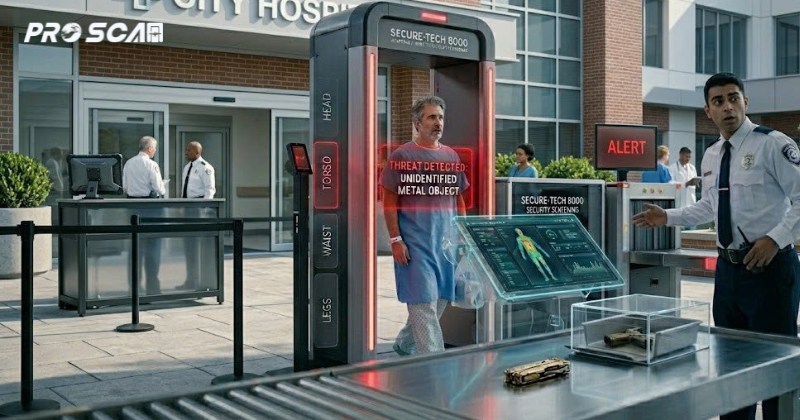
From reactive to proactive: A structural shift in security thinking
1. The end of reactive security
Traditionally, hospital security has been reactive. Cameras, guards, and incident response protocols were designed to act after something had already happened.
Today, that model is no longer sufficient. Violence is no longer treated as a rare exception but as a recurring operational risk.
Emergency departments, behavioral health units, and open access points are increasingly recognized as predictable pressure zones. These are not isolated weaknesses, but structural realities of how hospitals function.
2. Security as a system-level concern
As incidents become more frequent, the conversation shifts from isolated events to system-wide resilience. The question is no longer whether violence might occur, but how prepared the system is to prevent or absorb it.
This marks a transition from reactive security toward proactive risk control.
The economics of violence: From cost to investment
1. The financial reality
Workplace violence in healthcare carries a massive financial burden. Estimates place the annual cost at over 18 billion dollars, including treatment, staffing disruptions, legal exposure, and operational inefficiencies.
However, the significance of this number lies not only in its scale, but in how it reframes the issue.
2. Reframing security as ROI
Violence is no longer seen as an external or unpredictable factor. It is increasingly understood as a systemic risk with measurable financial consequences.
As a result, security is being repositioned. It is no longer a cost center, but an investment in operational continuity, workforce stability, and long-term institutional resilience.
Why hospitals are a unique security challenge
1. Unlike any other environment
Hospitals cannot adopt traditional security models used in airports, stadiums, or schools.
They cannot afford long queues or delays. They cannot restrict entry. They cannot fully control access points. Every decision must account for urgency, unpredictability, and high emotional stress.
2. Technical and operational constraints
Security systems must also meet strict technical requirements:
- They must not interfere with medical devices such as pacemakers or infusion pumps
- They must accommodate wheelchairs, mobility aids, and emergency transport
- They must minimize false alarms to avoid operational disruption
3. The invisible requirement
Perhaps the most important constraint is experiential. Security must exist without disrupting care.
In hospital environments, the ideal system is one that works effectively while remaining almost invisible to patients and staff.
4. The role of policy
Regulation is accelerating this transformation. California’s AB 2975 mandates the implementation of automated weapon detection systems at key hospital entry points within a defined timeline.
5. The “California effect”
While the law applies to a single state, its implications are broader. Large healthcare systems operating across multiple regions tend to standardize their practices based on the most stringent regulatory environment.
This creates a ripple effect, where local legislation begins to shape national standards.
The rise of healthcare-specific security technology
1. A new market segment
As a result of these constraints, a new category of solutions is emerging. Not all weapon detection systems are suitable for hospitals.
What is developing is a distinct segment of healthcare-specific security technology, designed to integrate into clinical workflows rather than disrupt them.
2. From equipment to context-aware solutions
This shift reflects a broader change in the market. Vendors are no longer simply selling devices. They are increasingly expected to deliver solutions that align with the unique operational context of healthcare.
Compatibility, workflow integration, and patient safety are becoming as important as detection performance.
Beyond technology: The need for a layered approach
1. The need for a layered approach
Technology alone is not sufficient to address complex risks.
Weapon detection should be understood as one layer within a broader system that includes trained personnel, clear response protocols, behavioral assessment, and preventive strategies.
2. The risk of over-reliance
Focusing too heavily on a single solution risks optimizing the wrong layer. Effective security requires coordination across multiple dimensions, not just the deployment of advanced tools.
Redefining safety in healthcare
The integration of weapon detection systems in hospitals is not simply a technological trend. It represents a deeper transformation in how healthcare institutions define safety and responsibility.
The idea that hospitals are inherently safe is being replaced by a more complex reality. Safety must now be designed, implemented, and continuously managed.
In this context, the central question is no longer whether to invest in security, but how to do so without compromising the core mission of care.
The institutions that succeed will not only be more secure. They will be better equipped to operate in an environment where safety can no longer be assumed, but must be actively built.
ProScan: The future of intelligent security inspection.
- 20+ Years of R&D excellence;
- Robot-automated manufacturing for 100% coil stability;
- Full spectrum OEM/ODM: walkthrough metal detector, handheld and shoe scanners.
Partner with us now:
- Website: proscanglobal.com;
- Email: support@proscanglobal.com;
- Phone number: (+84) 328 272 117;
- Facebook: facebook.com/proscanglobal/.
Looking for Advanced Security Inspection Solutions?
Partner with ProScan to secure your facilities with our high-performance metal detectors, walkthrough systems, and custom security solutions.
Source:
The rise of weapon detectors in hospitals — Campus Security today. (n.d.). Campus Security Today. https://campussecuritytoday.com/articles/2026/03/print/the-rise-of-weapon-detectors-in-hospitals.aspx?Page=1