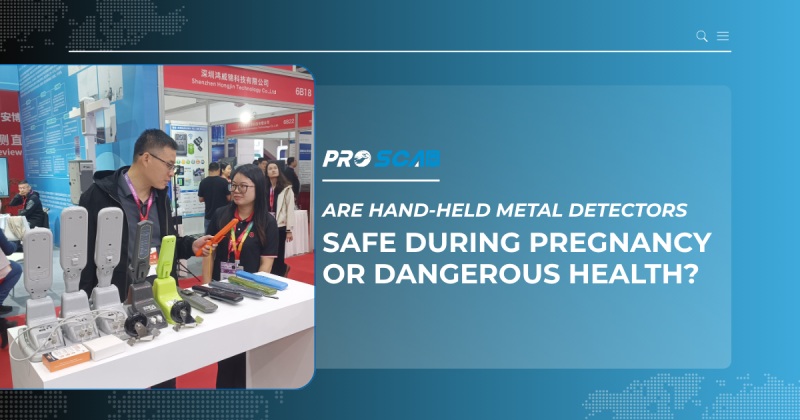
As portable screening devices become a staple of daily life, a vital question has surfaced: are hand-held metal detectors safe? This inquiry is particularly relevant for stakeholders who manage high-traffic checkpoints where individuals may be screened multiple times a week. At ProScan Global, we prioritize the balance between uncompromising security and biological safety. Understanding the electromagnetic principles of these devices is the first step in demystifying their impact on the human body.
How handheld metal detectors work?
To understand if hand held metal detectors are safe, one must look at the science of low-frequency electromagnetics. Unlike X-ray machines, which use ionizing radiation to “see through” objects, a handheld metal detector (HHMD) operates using non-ionizing electromagnetic induction.
The device contains a search coil that serves as both a transmitter and a receiver. When powered on, the detector generates a very low-frequency magnetic field around the search head. If this field encounters a metallic object, it induces “eddy currents” within that metal, which then creates a secondary magnetic field. (1)
The detector’s internal processor, such as the MCU found in the ProScan 620 series, senses this change and triggers an alarm. Because the magnetic field emitted is extremely weak – often less than what is produced by a standard household hair dryer or a set of headphones – the physical interaction with biological tissue is negligible. This foundational technology is designed to interact only with conductive materials, ensuring that the human body remains unaffected during the search process.
Are hand-held metal detectors safe for humans?
The short and definitive answer to the primary concern is: yes, are hand-held metal detectors safe for humans across all general demographics. Extensive scientific research and decades of operational data have shown that the low-level magnetic fields used in security wands do not possess enough energy to damage DNA or alter cellular structures.
They are safe for daily repeated use – for employees in high-security facilities who must pass through checkpoints every morning and evening, the cumulative exposure remains well within the safety margins established by global health organizations. Because the field is only active in short bursts and the exposure duration per person is usually less than thirty seconds, there is no evidence to suggest that frequent screening poses a long-term health risk.
When organizations ask are metal detectors harmful, they are often confusing electromagnetic induction with ionizing radiation. Modern HHMDs, especially those engineered by ProScan Global, are designed to emit the minimum amount of energy required to achieve precise detection, ensuring that the health of the individual is never compromised for the sake of security.

1. Are hand-held metal detectors safe around medical devices?
A frequent concern for facility managers involves the interaction between security hardware and life-sustaining medical equipment, such as pacemakers, defibrillators, or insulin pumps. When assessing if hand-held metal detectors are safe in these contexts, the focus is on Electromagnetic Compatibility (EMC).
Modern medical implants are engineered with robust internal shielding to protect them from everyday electromagnetic “noise.” Because a handheld metal detector utilizes a low-intensity, non-ionizing magnetic field, it does not typically generate enough energy to inhibit the function of a pacemaker or alter its programming.
International regulatory bodies, including the ICNIRP, have established that at standard operating distances, the magnetic flux density of an HHMD is insufficient to cause an asynchronous pacing event. However, as a best practice, ProScan Global recommends that security personnel avoid holding the detector directly over an implanted device for an extended period. A swift, continuous sweep remains the safest and most effective method for screening individuals with medical implants. (2)
2. Are hand held metal detectors safe during pregnancy and children?
The hand held metal detectors are safe during pregnancy and children; are hand held metal detectors safe during pregnancy has been studied extensively. Because the non-ionizing radiation emitted is extremely low-frequency, it does not have the energy to penetrate deep tissue or affect cellular development. The exposure is lower than what one might experience standing near a microwave or using a mobile phone. Similarly, for children, the low-energy field poses no risk to developing neurological or biological systems.
International safety standards for hand-held metal detectors
The safety of a security device is not a matter of manufacturer claims alone; it is verified by strict international certifications. For B2B partners and government procurement officers, these certifications are the only way to verify if hand-held metal detectors are safe for public deployment.
- CE compliance: This is the primary European standard, ensuring that the device meets health, safety, and environmental protection requirements. Every ProScan Global detector is CE-certified, proving that its electromagnetic emissions are far below the limits that could interfere with human biology.
- FCC certification: In the United States, the Federal Communications Commission regulates the “noise” or interference a device can emit. FCC certification ensures the detector doesn’t interfere with other vital communication equipment and operates within safe frequency bands.
Importance of certification in government procurement: In the public sector, utilizing uncertified equipment is a significant liability. Choosing certified hardware ensures that the organization is protected against legal claims regarding the question: are metal detectors harmful?

Operational safety best practices for organizations
To ensure that the answer to are metal detectors harmful remains a firm “no” within your organization, proper training is essential. Safety is as much about the operator as it is about the hardware.
- Maintain recommended sweep speeds: Moving the detector at a steady pace (roughly 3 to 10 cm per second) ensures that the target is identified without unnecessary prolonged exposure to the localized field.
- Maintain distance: The search head should be held approximately 2 to 5 cm from the subject’s body. This distance is optimal for detection sensitivity while ensuring a non-invasive experience for the individual.
- Use certified equipment: Only deploy hardware that carries legitimate CE and FCC markings. This guarantees that the “Are hand-held metal detectors safe?” The question has already been answered by independent laboratory testing.
Hand-held metal detector safety solutions from ProScan Global

ProScan Global provides an elite range of handheld solutions, specifically designed to meet the highest human safety thresholds. Our flagship models, such as the 620S Max and the 720 PRO, feature:
- Adaptive sensitivity: This allows for precise detection without the need to increase electromagnetic output power.
- Ergonomic design: Reducing the risk of repetitive strain for the officer, ensuring that the safety of the staff is prioritized alongside the safety of the public.
- Low-battery voltage protection: Ensuring that as power dips, the electromagnetic field remains stable and within safety parameters rather than oscillating or becoming erratic.
Partner with us now:
- Website: proscanglobal.com;
- Email: support@proscanglobal.com;
- Phone number: +
- Facebook: facebook.com/proscanglobal/.
FAQs about hand-held metal detector safety
1. Can security staff use them all day safely?
Yes, security staff can use these devices safely all day. Security personnel can operate handheld throughout their entire shift with complete peace of mind. Because these devices utilize low-frequency, non-ionizing electromagnetic fields, they do not emit harmful radiation and have no cumulative biological effect on the human body. The energy levels produced by a professional-grade wand are significantly lower than those emitted by common household electronics, such as mobile phones or Wi-Fi routers.
2. Do they affect smartphones or watches?
Modern HHMDs are designed to detect metal, not to wipe data. While they generate a magnetic field, it is not strong enough to damage the flash memory of a smartphone or the internal movement of a high-quality watch. However, they will, of course, trigger an alarm if held near these items.
The question are hand-held metal detectors safe must be answered with scientific transparency. Through the use of low-frequency, non-ionizing electromagnetic induction, these devices provide a critical layer of protection without posing a risk to biological health. By adhering to international certifications like CE and FCC, ProScan Global ensures that our technology meets the most stringent safety mandates in the world.