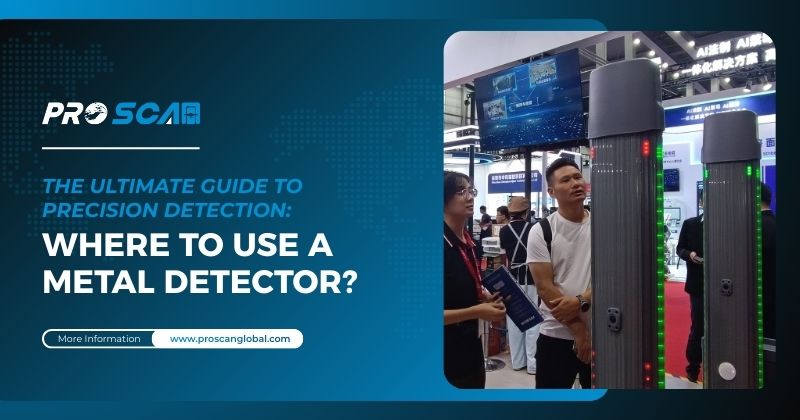
Whether you are a security equipment dealer or a facility manager, the question of where to use a metal detector is the most critical factor in your strategy. At ProScan Global, we understand that different environments demand different tactics, from the airport to the highly mineralized sands, to the sensitive electronic halls of a modern medical facility. By understanding the unique characteristics of each location, you can optimize your equipment settings, enhance your sensitivity, and ensure that no target-or threat-goes undetected.
Where to use a metal detector?
Identifying the ideal location is a blend of research, legal awareness, and environmental analysis. Success in detection is rarely accidental; it is a result of matching the right technology with the right terrain. Below, we explore the primary locations where detection technology is not just beneficial, but often essential:
1. Airport
In the realm of aviation, detection technology is the primary line of defense. Airports utilize a combination of walk-through and handheld units to ensure that no prohibited metallic items enter sterile zones. These environments require high-throughput machines that can differentiate between harmless personal items, like belt buckles, and genuine threats.
If you are analyzing where to use a metal detector for maximum public safety, the airport terminal serves as the benchmark for reliability. Here, detection is about precision and speed, ensuring that the flow of thousands of passengers is not hindered while maintaining a 100% detection rate for dangerous objects. Consult with ProScan regarding the security system for this case.
2. Beaches
In recent times, the role of detection technology on public beaches has expanded far beyond a mere hobby.
Following the devastating 2025 Bondi Beach terror attack, where gunmen targeted a community festival, there has been a global shift toward integrating proactive security measures in open coastal spaces.
Professionals at ProScan Global recommend using Pulse Induction (PI) or Multi-Frequency detectors. For security applications in these sensitive zones, they provide the precision necessary to identify potential threats without being compromised by the harsh, mineralized conditions of the coast.
3. Government buildings and corporate finance
Unlike recreational areas, determining where to use a metal detector in civil administration and high-level commerce is dictated by the need to protect sensitive information, high-value assets, and public officials.
In government buildings, detection systems are deployed not only at main public entrances but also at restricted access points to sensitive archives or legislative chambers. Similarly, in corporate finance centers and bullion vaults, the focus shifts toward internal loss prevention and the exclusion of sophisticated electronic eavesdropping devices.
ProScan Global’s integrated security approach for these facilities involves a multi-layered strategy: walk-through metal detectors are calibrated to detect even the smallest micro-circuitry or metallic threats, while handheld scanners allow for targeted inspections in VIP areas.
For corporate offices handling large volumes of data or physical currency, knowing where is the best place to use a metal detector often involves securing “clean zones”-areas where no external metallic or electronic devices are permitted to enter or leave. This ensures that institutional integrity is maintained through a rigorous, non-intrusive, yet absolute technological barrier.
4. Event
From music festivals to political rallies, large-scale events present a unique security challenge. Temporary security checkpoints are established to scan attendees quickly as they enter. In these scenarios, the portability of the equipment is key. Handheld metal detector are often used in tandem with portable walk-through gates.
Knowing where to use a metal detector at an event usually means focusing on “bottleneck” points-entrances and VIP access zones-where security can be tightly controlled without creating massive delays for the crowd.
5. Campgrounds and sports fields
In locations such as recreational campgrounds or large-scale sports complexes, the high density of people necessitates a professional-grade screening perimeter. Identifying where to use a metal detector in these environments means focusing on high-traffic transition points, such as the entry gates to stadium sidelines or communal assembly areas.
In these settings, a walk-through metal detector is the most effective tool for processing large groups quickly, providing a consistent standard of safety. To support this, handheld metal detectors are deployed for precision secondary screening, allowing security staff to resolve alarms by pinpointing specific metallic objects without physical contact.
When configuring these devices for high-activity zones, it is vital to adjust sensitivity and discrimination levels to filter out common “clutter” like foil wrappers or pull-tabs, ensuring the sensors remain focused on detecting genuine threats such as weapons or prohibited gear.
By placing these units at strategic bottleneck locations, security teams can maintain a secure environment while allowing the event to proceed without unnecessary delays.
6. Subway station
In major metropolitan hubs, the subway system is the lifesaver of the city, transporting millions of commuters daily. However, the open nature of these stations makes them vulnerable to pre-planned acts of violence. The chilling case of the 2024 Taichung Metro knife attack, where the assailant was found to have meticulously planned his assault for over a year, underscores that modern threats are often calculated and patient.
This reality makes the question of where to use a metal detector in a subway environment more critical than ever, despite the logistical challenge posed by the sheer volume of metal present in the infrastructure itself.
To overcome this, security teams at ProScan Global recommend utilizing specialized sensors that can filter out the ambient noise of trains and tracks. By strategically placing walk-through detectors at ticket barriers and using handheld units for random, targeted inspections, transit authorities can identify concealed weapons before they enter the carriage. This layered approach allows authorities to significantly deter the carriage of illicit items without halting the flow of the morning rush.
7. Hotels
In high-end hospitality, security must be effective yet discrete. Luxury hotels often use detection technology at service entrances to prevent the theft of hotel property or at main entrances during high-profile conferences.
Understanding where to use a metal detector in a hotel involves balancing guest privacy with the need for a secure environment. Modern, sleek walk-through detectors are often integrated into the decor to provide safety without creating an intimidating atmosphere.
8. Prison
Prisons represent the most rigorous application of detection technology. Here, the goal is the total exclusion of contraband. Detectors are used at every transition point-between cell blocks, in visiting rooms, and at all external gates.
In a correctional facility, the question of where are the best places to use a metal detector is answered by a strategy of “layered defense,” ensuring that even the smallest metallic shim or improvised weapon is detected before it can move from one zone to another.
9. School
Unfortunately, the modern era has necessitated the use of security measures in educational institutions. Many schools now utilize handheld or walk-through scanners at main entrances to ensure a weapon-free zone.
When implementing detection in schools, the focus is on creating a “safety envelope” that protects students and staff. Determining places to use a metal detector in a school setting requires a sensitive approach that prioritizes the students’ psychological well-being while ensuring that the physical perimeter remains uncompromised.
10. Hospital
Hospitals are a unique environment for detection because of the presence of MRI (Magnetic Resonance Imaging) machines. These devices use powerful magnets that can turn metallic objects into dangerous projectiles.
Consequently, detection is used specifically at the entrances to MRI suites. Knowing where to use a metal detector in a hospital is a matter of life and death; it ensures that no person enters a high-magnetic zone with a concealed oxygen tank, a pocket knife, or even a pacemaker that hasn’t been cleared for entry.
11. Another place
The versatility of these devices extends far beyond the obvious. In the food industry, detectors are placed over conveyor belts to ensure no metallic fragments from machinery end up in consumer products.
In forensic investigations, police may use them at a crime scene to locate spent bullet casings or discarded weapons hidden in tall grass. In the mining and heavy industry sectors, determining where to use a metal detector is a matter of both asset protection and operational survival.
Even in the lumber industry, workers must know where to use a metal detector to scan old-growth logs for hidden nails or spikes before they hit the sawmill blades. Each of these “niche” locations proves that detection technology is a universal tool for safety and quality control.
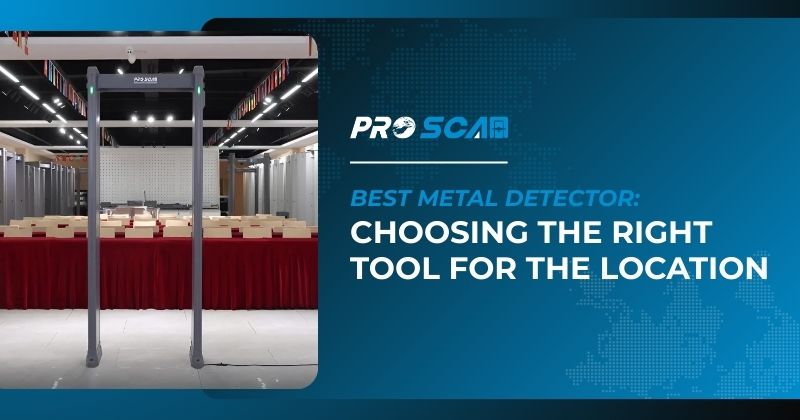
Best metal detector: Choosing the right tool for the location
Selecting the right equipment is just as important as knowing where to scan. At ProScan Global, we categorize our top-tier hardware into two primary groups based on their application and mobility.
1. Walk through metal detector
For high-traffic areas where speed and consistency are the priorities, the walk-through metal detector is the industry standard. These units create a multi-zone magnetic field that can pinpoint exactly where on a person’s body a metallic object is located-whether it’s at the ankle or the waist.
This is the best solution for where to use a metal detector in stadiums, large hotels, and prisons. By automating the detection process, these gates provide a reliable, objective standard of security that eliminates human error and ensures every individual is screened with the same level of scrutiny.
2. Handheld metal detector
The handheld metal detector is the ultimate tool for close-proximity scanning. These devices are lightweight, highly sensitive, and allow for a non-intrusive “pat-down” of an individual. They are the preferred choice for where to use a metal detector in schools, nightclubs, and at the final security gate of an airport.
Their high-frequency sensors are capable of detecting a tiny needle or a small blade hidden in clothing. For the professional, a handheld unit offers the agility to investigate specific areas without requiring a person to step into a fixed booth.
At ProScan Global, we are committed to providing the solution for every terrain. By understanding the unique challenges of your chosen location-be it a subway station, an airport, or a historical site-you can ensure that your detection efforts are both efficient and effective. No matter the destination, the right knowledge combined with professional-grade equipment ensures that you will always find what you are looking for, keeping people safe and history alive.
Determining where to use a metal detector is the foundation of any successful search or security protocol. From the vast, sun-drenched horizons of a public beach to the sterile, high-stakes environment of a hospital’s MRI suite, these devices serve as our silent sentinels. As ProScan Global have explored, the environment dictates the technology; a mining site requires rugged durability, while a school or hotel requires discrete but absolute precision.