
The science of weapon detection has transitioned from basic magnetic sensing to a high-stakes field of intelligent, multi-layered defense. For B2B stakeholders, government agencies, and facility managers, implementing a robust weapon detection system is no longer just a regulatory checkbox – it is a critical investment in public safety and organizational continuity. Whether securing a high-traffic transit hub or a sensitive government facility, the technology must be capable of distinguishing between everyday personal items and genuine threats with absolute precision. At ProScan Global, we are at the forefront of this evolution, engineering a global automatic weapon detection framework that integrates the latest advancements in electromagnetic induction and machine learning.

What is weapon detection?
Weapon detection is the use of technological sensors – ranging from low-frequency electromagnetic coils to advanced millimeter-wave arrays – to scan individuals or their belongings for prohibited items. A modern weapon detection system acts as an automated filter, using physics and digital signal processing to provide an immediate alert when an object’s signature matches a known threat profile.
This process must occur in milliseconds to ensure that security personnel can intervene at the point of entry, preventing the “inner perimeter” from being compromised. (1)
A professional-grade weapon detection system is calibrated to identify a broad spectrum of threats, including:
- Ferrous and non-ferrous firearms: Ranging from traditional steel-frame handguns to modern alloy and polymer-based firearms.
- Bladed weapons: Tactical knives, ceramic blades, and concealed shanks.
- Explosive components: Identifying the metallic shrapnel or timing mechanisms often associated with improvised devices.
- Non-traditional threats: Utilizing a sophisticated weapon detection model to flag items like 3D-printed weapons or micro-blades that might evade less sensitive equipment.
How weapon detection systems work?
The efficacy of a weapon detection system is rooted in its ability to interpret complex physical signals and translate them into actionable data. Modern systems typically utilize a combination of two primary technological pillars to achieve “zero-miss” reliability.
1. Metal-based detection technology
The most common form of weapon metal detectors operates on the principle of Electromagnetic Induction. Inside the search panels of a walk-through gate, transmitter coils generate a fluctuating magnetic field. When a person carrying a weapon passes through this field, the metal induces “eddy currents,” which in turn create a secondary magnetic field.
The receiver coils detect this change and analyze the signal’s phase, amplitude, and duration. By comparing this data to a pre-programmed weapon detection model, the system can determine if the object is a harmless set of keys or a concealed firearm.
2. AI-assisted detection and object recognition
The true revolution in weapon detection technology lies in the integration of Artificial Intelligence. Unlike legacy systems that only look at “how much metal” is present, an ai powered weapon detection system looks at the “signature” of the object. Using a high-fidelity gun detection model, the software can analyze the shape and density of the detected object in real-time.
This allows for the creation of an open gate weapon detection system, where patrons can walk through without emptying their pockets. The AI intelligently ignores smartphones and watches while alerting only on the specific geometric signatures of weapons, drastically reducing false alarms.
3. Real-time screening capabilities
In the world of global automatic weapon detection, speed is as important as accuracy. Modern systems are designed for high-throughput environments, providing real-time visual and audible alerts. When a threat is detected, the weapon detection system can pinpoint the exact location on the person’s body (e.g., left ankle or waist), allowing security staff to conduct a targeted search rather than a time-consuming full-body pat-down. This real-time processing is what allows weapon detection technology to function effectively in stadiums and transit hubs where thousands of people must be cleared every hour.
Types of weapon detection systems
Different operational environments require different hardware configurations. ProScan Global provides a versatile range of hardware designed to meet these diverse needs.
1. Walk-through weapon detection systems
These are the cornerstones of a permanent security checkpoint. An open gate weapon detection system provides a non-invasive, high-flow screening process. These gates are typically multi-zone, meaning they use a complex weapon detection model to identify the height and side of the body where a weapon is hidden. This format is essential for establishing a clear “hard line” at the entrance of a facility.
2. Handheld weapon detection devices
For secondary screening or mobile patrols, weapon metal detectors in a handheld “wand” format are indispensable. These devices allow security officers to perform a close-range scan of an individual who has triggered a walk-through alarm. Using the same weapon detection technology in a compact, ergonomic design, these wands provide the tactile precision needed to find small or expertly concealed threats during a manual search.
Applications of weapon detection across industries
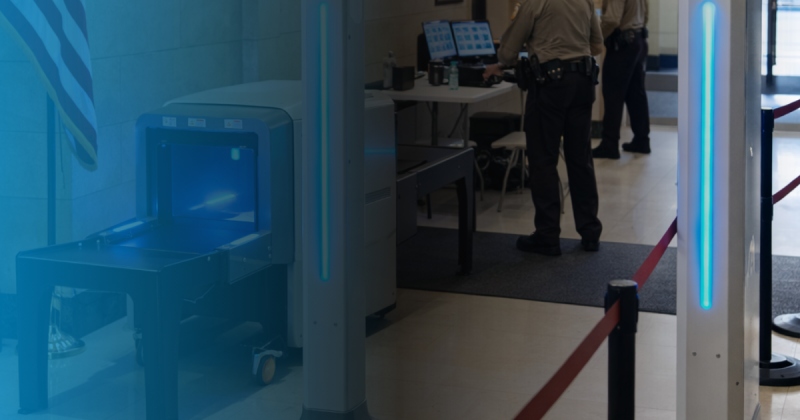
The implementation of a weapon detection system is not a “one-size-fits-all” solution. Different sectors face unique threat vectors, and the weapon detection technology must be calibrated to meet these specific environmental demands.
- Transportation hubs: In these high-stakes environments, global automatic weapon detection is mandatory. Here, the systems must operate with the highest level of sensitivity to detect even disassembled weapon components. By integrating an open gate weapon detection system, airports can maintain the high throughput required for international travel while ensuring that no metallic or non-metallic threat penetrates the secure zone.
- Schools and educational facilities: Safety in schools requires a delicate balance between rigorous protection and a welcoming atmosphere. Using an ai based weapon detection model, schools can screen students for knives and firearms without the intrusive experience of traditional “stop-and-empty” checkpoints. This “frictionless” approach ensures that the learning environment remains undisturbed while maintaining a hard line against violence.
- Government and public buildings: Courthouses and administrative centers are primary targets for targeted aggression. Deploying weapon metal detectors with multi-zone precision allows these facilities to intercept unauthorized items at the very first point of contact, protecting public servants and the democratic process.
- Stadiums and large events: The challenge of event security is the sheer volume of attendees. An open gate weapon detection system is the only way to process tens of thousands of fans in a narrow window of time. By utilizing weapon detection technology that ignores common items like belt buckles and coins, event organizers can prevent bottlenecks at the gates, reducing the risk of “soft target” crowds forming outside the venue.
Role of AI in modern weapon detection technology
The transition from traditional sensing to global automatic weapon detection is driven entirely by the evolution of Artificial intelligence. In the past, security guards were often overwhelmed by the high rate of false alarms generated by everyday objects. Today, the weapon detection model acts as a sophisticated digital filter.
By using a deep-learning gun detection model, the system is trained on millions of data points representing every possible orientation of a firearm. This AI allows the weapon detection system to differentiate between a curved metal umbrella handle and the distinct profile of a handgun barrel. Furthermore, as new threats emerge – such as 3D-printed polymer frames or low-metal-content blades – the weapon detection technology can be updated via software, ensuring that your hardware investment remains future-proof against the next generation of weapons.
Why choose ProScan Global for weapon detection solutions
Choosing a security partner is a decision that impacts the safety of thousands. ProScan Global stands as a world leader in the engineering and distribution of intelligent security inspection equipment. With a presence in the most demanding international markets, we don’t just sell detectors; we provide a comprehensive safety ecosystem.
Our commitment to global automatic weapon detection is built on:
- Advanced R&D: We constantly refine our weapon detection model to stay ahead of illicit manufacturing trends.
- Operational excellence: Our open gate weapon detection systems are designed for 24/7 high-intensity use in all weather conditions.
- Global support: With ProScan Global, you receive staff training, and technical support that ensures your weapon detection system is always operating at peak performance.
Whether you are looking for a high-volume weapon detection system for a transit hub or a set of precision weapon metal detectors, ProScan Global delivers the reliability and technical sophistication required for the modern world.
The evolution of weapon detection has fundamentally changed the way we secure public and private spaces. By moving toward a global automatic weapon detection framework, organizations can finally solve the age-old conflict between security and speed. The integration of advanced weapon detection technology and AI-driven gun detection models allows for a seamless, non-intrusive experience that identifies threats with surgical precision. As the world becomes more complex, the need for a reliable weapon detection system becomes a matter of institutional survival.