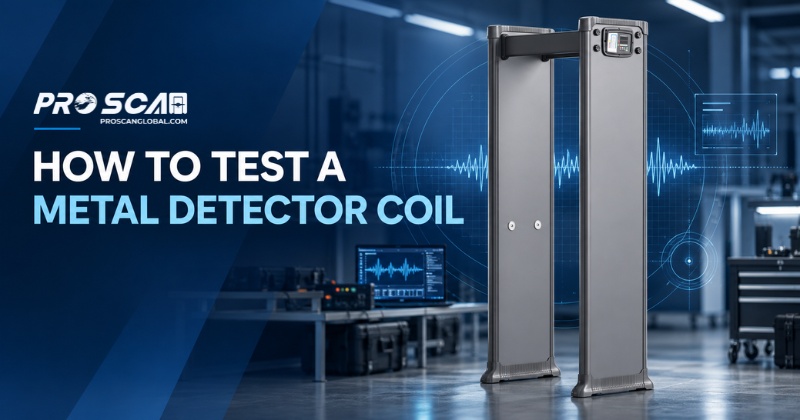
Whether managing entry flow at a commercial high-rise, securing a multi-modal transport terminal, or fortifying sensitive correctional facilities, the technology chosen to screen passengers and baggage must function with complete accuracy. Within this specialized B2B landscape, the selection of an OEM/ODM partner is driven by a single, non-negotiable metric: product quality. ProScan Global understands that a security screening system cannot operate on a margin of error. A slight drop in detection sensitivity, an unexpected electronic component failure, or a high rate of false alarms does more than disrupt foot traffic-it compromises facility safety, stalls operations, and exposes high-risk perimeters to severe vulnerabilities.
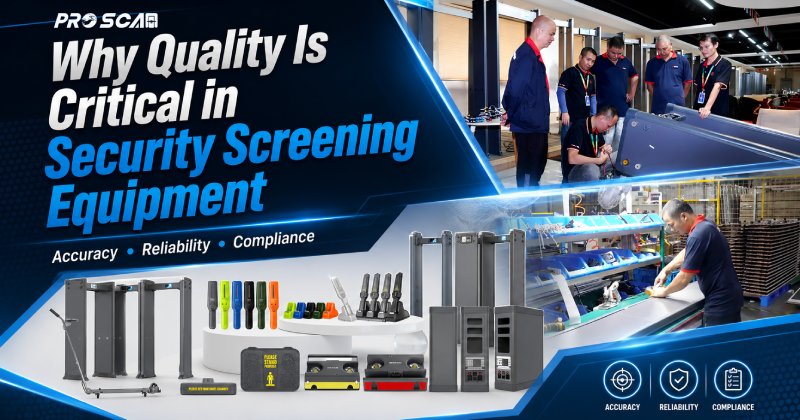
Why quality is critical in security screening equipment
For professional stakeholders navigating high-value tenders and long-term facility management, a deep understanding of why hardware quality dictates operational success is essential for protecting capital investments and reducing total cost of ownership (TCO).
1. Security decisions depend on detection accuracy
The primary function of any security checkpoint is to provide security personnel with clear, real-time data to make critical screening decisions. If an inspection system-whether a multi-zone Walk-through Metal Detector identifying hidden weapons, an X-ray Scanner visualizing baggage internals, or a Shoe Scanner vetting footwear-lacks precision engineering, its data output becomes unreliable.
Low-quality systems frequently suffer from signal distortion or “dead zones” where target objects go completely undetected. Conversely, poor calibration can cause excessive false alarms, triggering on harmless everyday objects. High quality ensures that digital signal processing (DSP) algorithms and induction fields remain perfectly balanced, providing clear detection accuracy that empowers security teams to act confidently.
2. Equipment reliability in high-traffic environments
Security equipment does not operate in controlled, low-impact environments. Walk-through gates and Under Vehicle Screening Systems (UVSS) stand as the front line of defense in high-traffic corridors, continuously exposed to physical friction, heavy vibration, and demanding, non-stop operational cycles.
Handheld metal detectors face even harsher treatment, being handled by multiple security shifts and subjected to frequent accidental drops. If the structural casings, internal boards, and connection wiring are not built to strict industrial standards, this relentless wear and tear leads to premature electronic drift or catastrophic mechanical failure, resulting in checkpoint bottlenecks and security protocol breaches.
3. Compliance with international security standards
In the B2B security sector, regulatory compliance serves as a primary gatekeeper for project eligibility. When international procurement committees issue high-value infrastructure tenders, they universally mandate compliance with globally recognized technical standards, such as CE, FCC, and specific radiation safety regulations for X-ray hardware.
Certified quality provides documented proof to system integrators, customs offices, and municipal safety inspectors that the equipment satisfies stringent electromagnetic compatibility, low-voltage safety, and health guidelines. Sourcing certified hardware shields partners from legal liabilities and customs bottlenecks, facilitating seamless project execution. (1)
Key quality challenges in security screening equipment
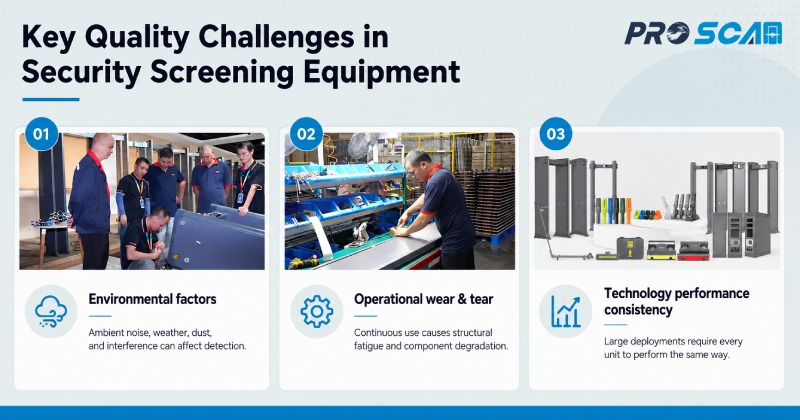
To build systems that achieve long-term field stability, an OEM/ODM manufacturer must directly address the complex physical and technological challenges that threaten hardware performance under real-world conditions.
1. Environmental factors and ambient interference
One of the most persistent hurdles facing intelligent security inspection equipment is environmental instability. In the field, hardware must regularly contend with intense ambient electronic noise emitted by nearby power generators, structural steel columns containing residual magnetism, or wireless communication networks.
Furthermore, outdoor installations, such as Under Vehicle Screening Systems, are continuously exposed to intense climatic stress, including extreme temperature shifts, torrential rain, and heavy dust infiltration. Without specialized internal shielding, industrial-grade weatherproofing, and advanced digital filtration algorithms, these environmental variables can corrupt sensor telemetry, causing phantom signals or blinding the detector to legitimate threats.
2. Operational wear and tear over extended lifecycles
The lifecycle of a security checkpoint is a marathon of continuous stress. Over months and years of constant deployment, the mechanical and electronic sub-assemblies of security devices undergo relentless degradation.
Continuous foot traffic through walk-through frames can loosen structural joints; repetitive scanning motions with handheld wands strain internal power connections; and the constant weight of personnel stepping onto specialized shoe scanners tests structural load limits daily. If a manufacturer cuts corners on raw materials or structural design, this operational strain causes early housing failure, sensor displacement, and internal component misalignments that require frequent, expensive maintenance dispatches.
3. Technology performance consistency across large-scale deployments
For global B2B distributors and system integrators managing massive multi-site deployments, batch-to-batch product consistency is critical. When a project requires the installation of hundreds of security screening nodes across an entire infrastructure network, “Unit #1” must perform identically to “Unit #500.”
In lower-tier manufacturing setups, manual assembly variances can cause slight differences in coil winding tension or circuit board soldering. This lack of production consistency means that each machine behaves slightly differently in the field, turning calibration, firmware synchronization, and routine technical maintenance into a complicated logistical challenge for local engineering teams.
How ProScan Global ensures superior product quality
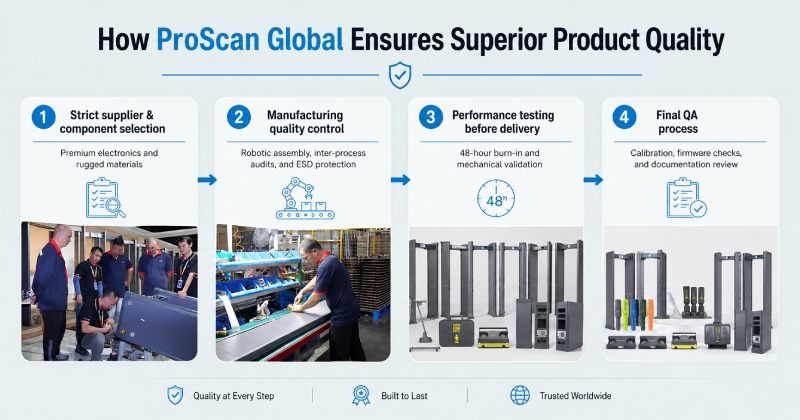
To overcome the challenges of environmental interference, physical wear, and deployment consistency, ProScan Global has integrated a strict, multi-tiered quality management system directly into our product lifecycle. We manage quality not as a final inspection step, but as a continuous engineering protocol from component sourcing to final container loading.
1. Strict supplier and component selection
Superior product quality begins long before assembly with the selection of raw materials and electronic components. ProScan operates a rigorous supplier vetting system that evaluates every vendor on precision, batch consistency, and failure rates.
- Premium electronics: We source high-grade integrated circuits, microprocessors, and digital signal processing (DSP) chipsets from top-tier global manufacturers, ensuring our boards handle complex algorithm execution without overheating or dropping signals.
- Ruggedized structural materials: For our handheld metal detectors and walk-through panel shells, we utilize impact-resistant and reinforced structural composites that endure intense daily handling without fracturing.
- High-fidelity sensor arrays: The copper wiring and induction coils used in our multi-zone gates and shoe scanners are checked for purity and thickness, guaranteeing uniform electromagnetic fields that prevent detection of dead zones.
2. Comprehensive manufacturing quality control
Our manufacturing facility operates under automated precision to minimize human assembly error and ensure that every unit matches our core design specifications.
- Robotic coil winding and assembly: By utilizing robotic automation for winding our induction coils and mounting components onto PCBs, we ensure uniform electrical characteristics across every single machine.
- Inter-process quality audits: Production is divided into distinct, monitored assembly stations. A unit cannot advance from structural assembly to electronic integration without clearing localized calibration, wiring continuity, and ground-fault insulation checks.
- Electrostatic discharge (ESD) protection: All assembly areas enforce strict ESD protocols, shielding sensitive micro-controllers and display panels from invisible static damage during the production loop.
3. Performance testing before delivery
Once a device completes final assembly, it enters our mandatory pre-shipment validation phase, where it is subjected to operational stress testing that simulates years of field use.
- 48-hour continuous burn-in test: Every walk-through gate, X-ray scanner, and under-vehicle screening system is powered on and run continuously for a minimum of 48 hours to identify and eliminate early-stage component infant mortality.
- Mechanical abuse validation: Handheld wands and portable scanners undergo rigorous vibration platform analysis, ensuring that the internal shock mounts hold the sensor arrays completely static under heavy impacts.
4. Final quality assurance process
The final gatekeeper in our quality framework is an independent Quality Assurance (QA) team that acts directly on behalf of our B2B clients. Before any batch is cleared for logistical packaging, QA technicians execute a standardized inspection checklist:
- Standardized target calibration: Units are tested using industry-standard metallic test pieces and calibration blocks to confirm that multi-zone tracking, mass discrimination, and visual alarms align perfectly with security guidelines.
- Firmware and software audits: Technicians verify that the latest stable firmware version is properly flashed and that all digital diagnostic features, remote monitoring connections, and language settings operate correctly.
- Complete documentation verification: We ensure that every shipment includes detailed technical schematics, user manuals, and certified CE/FCC declarations of conformity, giving your integration teams immediate regulatory clearance.
Why customers choose ProScan Global
Global system integrators, distributors, and procurement teams choose ProScan Global because we bridge the gap between advanced technology and low total cost of ownership. Our extensive product portfolio-spanning Walk-through Metal Detectors, Handheld Wands, Shoe Scanners, high-precision X-ray Scanners, and Under Vehicle Screening Systems (UVSS)-allows clients to source a complete, multi-layered security checkpoint from a single, high-tech manufacturer.
By choosing ProScan Global as an OEM/ODM partner, B2B networks eliminate the risks of dealing with multiple uncertified vendors. Our commitment to automated manufacturing precision, exhaustive pre-shipment endurance testing, and full international compliance means fewer field failures, minimized emergency technical dispatches, and sustained project profitability.
Partner with us now:
- Website: proscanglobal.com;
- Email: support@proscanglobal.com;
- Phone number: +84 328272117;
- Facebook: facebook.com/proscanglobal/.
In the professional security landscape, product quality is the ultimate foundation of operational stability and perimeter safety. As we have explored throughout this article, achieving reliable detection accuracy and long-term equipment durability requires far more than basic hardware assembly; it demands strict component vetting, automated manufacturing precision, and rigorous pre-shipment testing. Through our unyielding commitment to engineering excellence and comprehensive quality control, ProScan Global ensures that your checkpoints remain uncompromised, efficient, and fully compliant with international standards.