
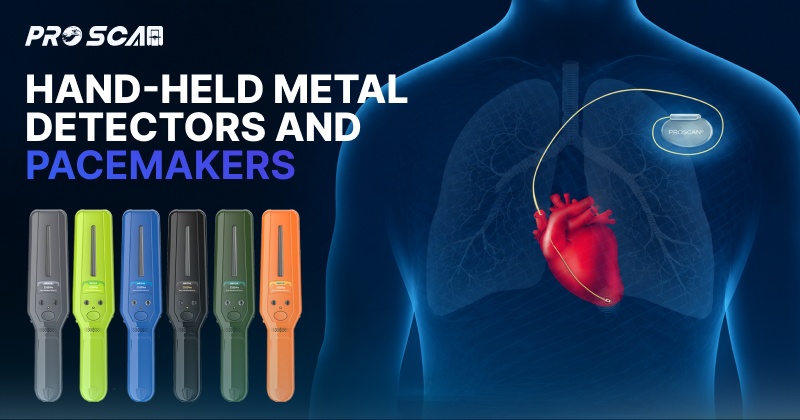
As security checkpoints become a standard feature of our daily lives a common concern has emerged among the millions of people living with life-saving implants: do these scanners pose a risk? Navigating the relationship between hand-held metal detectors and medical devices requires a clear understanding of the physics behind the hardware and the stringent international standards that govern its use. For security integrators and facility managers, providing a safe screening environment is not just about detecting threats; it is about ensuring that every person, including those with cardiac or neurological implants, can pass through a checkpoint with absolute confidence.
How handheld metal detectors work?
A handheld metal detector operates on the principle of electromagnetic induction. Inside the ergonomic housing of a ProScan wand is a copper coil that acts as both a transmitter and a receiver. When the device is powered on, it generates a low-frequency alternating magnetic field. If this field encounters a conductive object, such as a firearm or a knife, it induces tiny electrical currents – known as eddy currents – within that object.
These currents, in turn, generate their own weak magnetic field, which is instantly picked up by the detector’s receiver coil. The system then processes this change in the field and triggers an audible or haptic alarm. It is important to note that this field is non-ionizing and operates at a very low power level, distinct from the high-energy waves used in medical imaging or communications.
Handheld detectors are the primary “tactile” tool in a security officer’s kit. They are typically used for secondary screening after a walk-through gate has been triggered or for primary screening in mobile environments. Their role is to provide a precise, close-range scan of an individual’s body to pinpoint the exact location of a metallic threat.
Because they are used in close proximity to the human torso, the design of these devices must account for the presence of internal medical hardware, ensuring that the hand-held metal detectors and medical devices interaction remains within safe biological parameters.
Types of implanted medical devices people are concerned about
The modern medical field utilizes a vast array of sophisticated electronic and structural implants. When individuals inquire about hand-held metal detectors and pacemakers, they are usually concerned about how an external magnetic field might affect the delicate sensors or the structural integrity of these devices.
- Cardiac pacemakers: These are the most common concerns. A pacemaker monitors the heart’s rhythm and provides electrical pulses when it beats too slowly. The primary fear is that the electromagnetic field from a wand could be misinterpreted by the pacemaker as a natural heartbeat, causing it to skip a necessary pulse.
- Implantable cardioverter defibrillators (ICDs): Similar to pacemakers, ICDs monitor for life-threatening arrhythmias. The concern here is “EMI oversensing,” where the device might mistake a security scan for a heart emergency and deliver an unnecessary shock.
- Cochlear implants: These hearing devices use external and internal magnets and electrodes to process sound. Users often worry about static or temporary sound distortion when a hand-held metal detector and medical device encounter each other during a scan.
- Metal orthopedic implants: While hip replacements, knee pins, and spinal rods do not contain electronics, they are made of conductive metals like titanium or stainless steel. While these won’t be “damaged” by a scan, they often trigger the alarm, necessitating a clear protocol for security staff to follow.
- Neurostimulators and insulin pumps: These devices rely on precise electronic programming to manage pain or deliver medication. Users often seek assurance that the magnetic field won’t cause a reset or an accidental delivery of a dose.
Do handheld metal detectors interfere with implanted medical devices?
The consensus among global health organizations and security manufacturers is that, when used correctly, there is no significant danger. However, the nuances of the hand-held metal detectors and medical devices relationship depend on field strength and screening duration.
1. Electromagnetic field strength in security scanners
The magnetic field emitted by a professional handheld detector is exceptionally weak. In technical terms, the “flux density” of a security wand is typically far below the limits set by the International Commission on Non-Ionizing Radiation Protection (ICNIRP). For perspective, the field produced by a wand is often less intense than the magnetic field emitted by a standard kitchen microwave or a high-end smartphone held to the ear. Because the field is so localized and the scan duration is so brief, the likelihood of it disrupting the internal circuitry of a modern medical implant is extremely low.
2. International safety recommendations for screening operators
Despite the low risk, organizations like the American Heart Association (AHA) and device manufacturers (such as Medtronic or St. Jude Medical) provide specific guidelines for the hand-held metal detectors and medical devices interaction. The standard recommendation is that security personnel should not hold the metal detector directly over the site of an implanted device (like a pacemaker) for an extended period. Instead, the scan should be a continuous, smooth motion. If a scan is performed quickly and the wand is not held stationary over the implant for more than a few seconds, the risk of “electromagnetic interference” (EMI) is effectively eliminated.
Comparison with walk-through metal detectors
When comparing walk-through gates to handheld wands, the handheld unit actually offers a more “surgical” approach to safety. A walk-through gate immerses the entire body in a magnetic field, whereas a handheld scan allows the operator to move the wand around sensitive areas. For individuals who are particularly anxious about hand-held metal detectors and pacemakers, the option for a manual “pat-down” or a specialized scan that avoids the chest area is a standard courtesy in professional security protocols.

Safety standards followed by professional handheld metal detector manufacturers
For a hand-held metal detectors and medical devices safety profile to be valid, the equipment must undergo rigorous testing against international benchmarks. Leading manufacturers do not simply claim safety; they prove it through standardized certification.
The primary regulatory bodies – such as the ICNIRP (International Commission on Non-Ionizing Radiation Protection) and the IEEE (Institute of Electrical and Electronics Engineers) – set the maximum allowable exposure for electromagnetic fields. Professional security hardware is engineered to operate at a fraction of these limits.
Furthermore, specific standards like EN 60335-1 (Safety of household and similar electrical appliances) and EN 50364 (Limitation of human exposure to electromagnetic fields) are applied during the design phase to ensure that the “leakage” or stray fields from a handheld wand are contained and controlled. By adhering to these strict manufacturing standards, the potential for interaction between hand-held metal detectors and medical devices is moved from the realm of risk to the realm of statistical impossibility.
Why choose ProScan Global for safe and reliable handheld metal detection solutions

At ProScan Global, we recognize that the individuals passing through our checkpoints are more than just subjects; they are patients, travelers, and citizens who deserve the highest standard of protection. Our commitment to the safe operation of hand-held metal detectors and medical devices is reflected in every unit we ship.
- Global compliance (CE and FCC): Every ProScan device is fully certified by the European Conformity (CE) and the Federal Communications Commission (FCC). These certifications ensure that our equipment meets the world’s most stringent requirements for electromagnetic compatibility (EMC) and health safety. When you deploy a ProScan solution, you are deploying a system that has been verified by independent third-party labs to be safe for all users, including those with hand-held metal detectors and pacemakers.
- Engineered electromagnetic stability: Our sensor technology focuses the magnetic field exclusively on the detection area. This “tight-field” engineering ensures that there is minimal field dispersion, meaning the energy is directed only where it is needed for screening and is not radiated unnecessarily toward the user’s internal medical hardware.
- OEM and ODM customization for global projects: We work closely with partners to provide customized screening protocols. Whether you require a specialized sensitivity setting for hospital entrances or an integrated training module for your staff on how to screen sensitive subjects, ProScan Global provides the technical depth to support your mission.
Partner with us now:
- Website: proscanglobal.com;
- Email: support@proscanglobal.com;
- Phone number:
- Facebook: facebook.com/proscanglobal/.
As we have explored, the interaction between hand-held metal detectors and medical devices is governed by precise engineering and a “safety-first” manufacturing philosophy. While it is natural for individuals with cardiac or neurological implants to seek clarity, the data remains consistent: professional security wands operate at such low power levels that they are essentially invisible to modern medical technology. By adhering to international recommendations – such as moving the wand in a steady motion and avoiding stationary placement over implants – security personnel can maintain a robust defense without compromising the health of the individual.
4 Responses