
The pulse induction metal detectors (PI metal detectors) are designed to operate in the most challenging environments, from “high-traffic environment” to noise electromagnetics, where traditional methods often fail. At ProScan Global, we specialize in deploying this robust technology to ensure that security threats and metallic contaminants are identified with uncompromising reliability. By understanding the underlying physics of these devices, organizations can better appreciate why the pulse induction metal detector has become the gold standard for high-performance detection across the globe.
What is a pulse induction metal detector?
To understand the necessity of this technology, we must first define its core identity and why it remains an indispensable tool for security professionals and industrial operators alike.
1. Definition of PI metal detector
A pulse induction metal detector is a specialized type of metal detection system that uses a single coil (or a specific arrangement of coils) as both the transmitter and the receiver. A PI system operates by sending powerful, short bursts-or “pulses”, of current through the search coil.
These pulses generate a magnetic field that collapses rapidly, allowing the device to listen for the “echo” of metallic objects without the interference of its own outgoing signal.
2. Why does pulse induction metal detector matter?
The significance of the pulse induction metal detector lies in its immunity to “ground noise.” In many geographical locations or industrial settings, the presence of conductive minerals (like magnetite) can cause standard detectors to trigger false alarms constantly. PI technology effectively “sees through” these minerals, focusing solely on the metallic targets.
For ProScan Global’s clients, this means fewer interruptions, deeper detection capabilities, and the ability to find targets that other technologies simply cannot reach. In high-stakes security, where a missed object could be catastrophic, the reliability of PI is not just a feature; it is a necessity.
Components of a pulse induction metal detector
The internal architecture of these machines is a masterclass in electrical precision. While the exterior might look similar to other detectors, the internal components are specifically tuned to handle high-voltage pulses and millisecond-timing.
- The control box: This is the “brain” of the operation. It houses the battery, the pulse generator, and the high-speed microprocessor. In modern units, this often includes a pulse induction metal detector with DSP (Digital Signal Processing) chip, which analyzes the incoming signal decay to filter out environmental noise.
- The search coil: Unlike VLF systems which require two distinct, balanced coils, a PI system can function with one. This coil acts as an inductor that stores and releases energy in rapid succession.
- The timing circuit: This is perhaps the most critical component. It controls exactly when the pulse is sent and how long the device waits before it starts “listening” for the return signal.
- The sampling gate: This component captures the voltage at specific intervals after the pulse has ended. By sampling the signal at different points in time, the detector can distinguish between the fast-decaying signals of ground minerals and the slower-decaying signals of metallic objects.
How does a pulse induction metal detector work?
Understanding how pulse induction metal detectors work requires a look into the “time-domain” of electromagnetics. Unlike frequency-domain detectors that look for phase shifts, a PI detector looks at the behavior of a magnetic field over time.
The process begins when the battery sends a high-current pulse through the search coil, creating a strong magnetic field. When this current is abruptly switched off, the magnetic field collapses with incredible speed, generating a high-voltage spike. If there is a metallic object within range, the collapsing magnetic field induces a “circular” electrical current-known as an eddy current, inside that object.
These eddy currents don’t disappear instantly; they linger for a few milliseconds, creating their own weak, secondary magnetic field. Because the detector’s primary field is now turned off, the coil can switch to “receive mode” and pick up this faint secondary field. The detector then measures the rate at which this induced field decays.
Harder-to-detect metals or larger objects will have a slower decay rate, which the system interprets as a positive hit. Because the pulse induction metal detector frequency is generally lower and the pulses are discrete, it allows for through shielding materials than continuous-wave systems. (1)
Read more: How does a metal detector work?
Advantages and limitations of pulse induction metal detectors
While the pulse induction metal detector is a powerhouse of detection, it is important to understand where it excels and where it requires a strategic approach.
1. Advantages of pulse induction metal detectors
Pulse Induction (PI) technology provides a decisive advantage in complex environments where standard detection methods fail. Here are the core benefits of PI-integrated systems:
- Superior penetration power: Walkthrough and handheld detectors identify metallic threats at significantly greater distances than standard VLF units, ensuring that deeply concealed or small, high-threat objects are captured with precision.
- Immunity to conductive noise: Unlike traditional detectors that struggle with reinforced steel, concrete, or high-moisture conditions, PI systems are virtually unaffected by wet surfaces or architectural interference.
- Ideal for challenging locations: The resistance to environmental noise makes these units the only viable choice for high-traffic checkpoints in coastal areas, transit hubs, or industrial sites where false alarms are common.
- Advanced mineral rejection: In environments with high “mineral noise” – such as volcanic soil or metallic dust, standard detectors can be “blinded,” but a PI detector effectively ignores these background responses.
- Focused threat detection: By filtering out geological and structural interference, this technology allows security personnel to focus strictly on identifying ferrous and non-ferrous metal detector threats, such as weapons or contraband, even in hostile conditions.
2. Limitations of PI metal detectors
While Pulse induction (PI) technology offers superior depth and stability, it faces specific historical challenges:
- Discrimination challenges: The primary hurdle with traditional PI technology has always been pulse induction metal detector discrimination. Because the system analyzes signal decay rates rather than phase shifts, distinguishing between common iron (like a nail) and valuable non-ferrous items (like gold coins or copper weapons) has historically been difficult.
- High power consumption: PI detectors typically require higher power because of the high-current pulses needed to generate effective magnetic fields. (2)
However, with the advent of the pulse induction metal detector with DSP, ProScan Global has been able to mitigate many of these limitations.
Modern digital processing allows us to analyze the “shape” of the decay curve more accurately, providing better (though still not perfect) discrimination and significantly improved battery efficiency compared to older analog models.
Types of pulse induction metal detectors
ProScan Global utilizes PI technology across a spectrum of hardware designs in the walk through metal detector and handheld metal detector, ensuring that the depth and reliability of pulse induction are available regardless of the deployment scenario.
1. Walk-through metal detectors
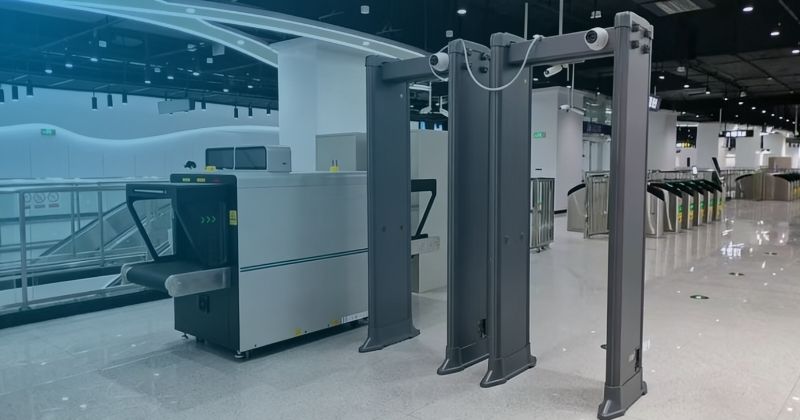
In high-traffic venues such as airports or government headquarters, walk-through gates integrated with PI technology offer superior throughput. Because how pulse induction metal detectors work involves a high immunity to external metallic structures (like rebar in the floor), these gates can be installed in locations where VLF systems would fail.
ProScan Global’s PI walk-through systems provide multi-zone detection, allowing security personnel to pinpoint exactly where on a person’s body a metallic object is located, even if that object is non-magnetic or concealed behind heavy clothing.
2. Handheld pulse induction metal detectors
The handheld pulse induction metal detector is a vital tool for tactical security and forensic recovery. Unlike standard security wands that may struggle with environmental interference, PI-based handhelds are frequently used in marine environments or at muddy outdoor events.
These devices are compact yet contain the sophisticated pulse induction metal detector with DSP (Digital Signal Processing) required to isolate small targets like jewelry or electronic components in highly conductive environments. Their ruggedized construction makes them the preferred choice for law enforcement and demining teams operating in harsh climates.
ProScan Global OEM/ODM pulse induction metal detectors system
As one of the leaders in security solutions, ProScan Global offers comprehensive OEM and ODM services for clients requiring bespoke detection systems. We understand that a “one size fits all” approach does not work for global security. Our pulse induction metal detector systems can allow for specific adjustments to the pulse induction metal detector frequency and pulse width to suit your local environmental challenges.
By choosing ProScan Global, you are gaining access to the latest advancements in pulse induction metal detector discrimination. Our proprietary DSP algorithms allow our PI systems to achieve levels of target identification previously thought impossible for this technology.
Whether you need a branded walk-through solution for a corporate campus or a specialized sensor for industrial integration, our engineering team ensures that your PI system is optimized for sensitivity, durability, and ease of use.
The pulse induction metal detector remains a cornerstone of high-level security and industrial safety due to its raw power and environmental resilience. While the technology requires a deep understanding of electromagnetics to master, its ability to find targets where others cannot make it an essential investment for any serious security operation. At ProScan Global, we are committed to pushing the boundaries of how pulse induction metal detectors work, integrating digital processing and advanced discrimination.

3 Responses
So professional manufacture