
Implementing a comprehensive security framework requires a sophisticated blend of access control, perimeter management, and screening hardware. Central to this modern approach is the integration of a metal detector in school checkpoints, serving as a vital frontline deterrent and detection mechanism. This guide provides an in-depth analysis of school security systems, exploring operational efficiencies, real-world utility, and strategic manufacturing standards to help educational administrators secure their campuses effectively.
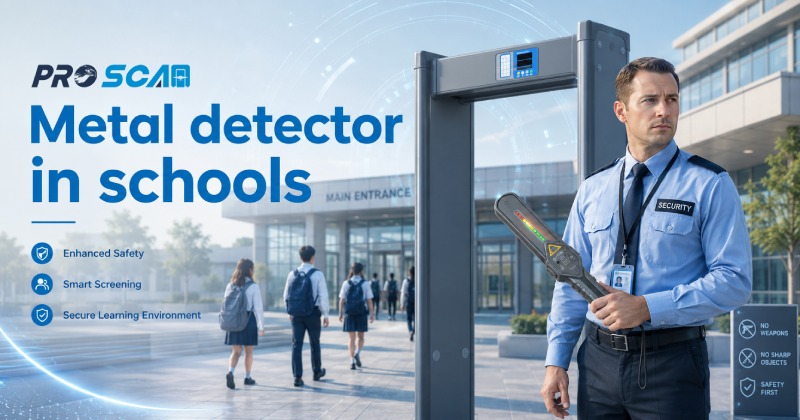
Are metal detectors in schools effective?
Metal detectors can be effective as part of a broader school security strategy because they help identify concealed metallic objects at controlled entry points. Their effectiveness depends heavily on equipment quality, screening procedures, staff training, and how the system is integrated with other security measures.
When educational facilities evaluate security upgrades, the core inquiry centers on whether screening portals truly achieve their intended safety objectives. The operational reality is that a metal detector in school environments functions as an active deterrent and a systematic screening filter, but it is not a standalone solution.
The effectiveness of metal detectors in schools is directly tied to the precision of the hardware and the consistency of the protocols enforced by security personnel. When administrators ask, are metal detectors in schools effective, the consensus among security experts and institutional leaders is that success relies entirely on systemic integration.
A high-quality walk-through metal detector engineered by industry leaders like ProScan Global utilizes multi-zone electromagnetic induction to pinpoint metallic objects accurately. However, if screening procedures are poorly managed, or if students bypass checkpoints through unmonitored side doors, the technology’s potential is undermined. Therefore, determining how effective are metal detectors in schools requires looking beyond the hardware itself to examine staff preparedness, queue management, and community cooperation.
When properly calibrated and supported by comprehensive access control policies, these systems successfully intercept unauthorized metallic items, providing a reliable layer of defense that reassures parents and protects students. Furthermore, studies addressing are metal detectors effective in schools emphasize that visible screening hardware acts as a powerful psychological deterrent, significantly reducing the likelihood that individuals will attempt to introduce prohibited weapons onto campus grounds.
Metal detectors in high schools: Where and how are they used?
Deploying security infrastructure within secondary educational facilities requires strategic placement to manage high-volume student arrivals while maintaining absolute control over campus access points. Understanding where and how screening equipment is utilized ensures optimal protection.
The deployment of metal detectors in high schools involves specialized architectural and operational planning tailored to the unique rhythms of an academic day. Unlike corporate or government buildings with steady, staggered arrival times, schools experience massive surges of students attempting to enter the facility within a narrow 15-to-30-minute window before the morning bell.
Consequently, security layouts must balance uncompromising threat detection with high-speed throughput to prevent dangerous bottlenecks outside building entrances. ProScan Global designs advanced walk-through and handheld detection systems specifically configured to handle these high-density educational environments, ensuring seamless operational flow.
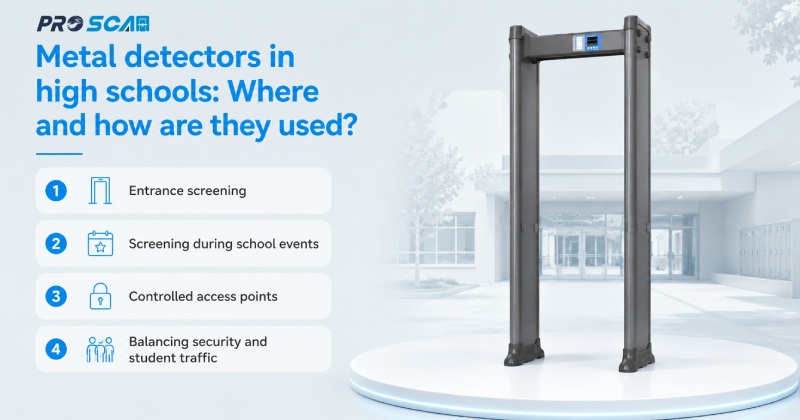
1. Entrance screening
Main entrance screening represents the primary line of defense for secondary educational institutions. By funneling all arriving students, staff, and visitors through designated access corridors equipped with multi-zone walk-through metal detectors, school security teams establish a mandatory inspection threshold.
This centralized approach ensures that every individual entering the campus passes through an active electromagnetic field, allowing security personnel to detect concealed metallic weapons instantly. Strategic placement of these portals at main foyers or dedicated security vestibules prevents unauthorized entry while maintaining an organized, orderly queue.
2. Screening during school events
Beyond daily morning arrivals, high schools frequently host high-occupancy extracurricular activities-such as Friday night football games, basketball tournaments, indoor graduation ceremonies, dances, and theatrical productions-that draw large crowds from outside the immediate student body.
During these public events, the risk profile of the campus shifts significantly, requiring flexible security deployments. School security teams utilize portable inspection configurations, pairing walk-through gates at gymnasium or stadium gates with high-sensitivity handheld metal detectors for secondary bag checks and targeted screening, ensuring external visitors comply with campus safety policies.
Read more: Top 3 best handheld metal detector.
3. Controlled access points
To maximize the efficacy of campus security, educational facilities must eliminate unmonitored entry vectors. Deploying metal detectors in high schools is only effective if all secondary doors, emergency exits, and perimeter gates are locked or electronically monitored against unauthorized re-entry.
Security administrators establish a controlled access perimeter, channeling all foot traffic through designated checkpoints where walk-through detectors are installed. This architectural discipline ensures that no individual can bypass the screening apparatus, preserving the integrity of the institution’s security perimeter.
4. Balancing security and student traffic
One of the most delicate operational challenges in educational security is maintaining strict safety standards without turning the school entrance into an intimidating, prison-like checkpoint or causing severe tardiness. Achieving this balance requires high-throughput detection hardware that minimizes nuisance alarms caused by everyday items like belt buckles, keys, or binders.
By utilizing advanced digital signal processing and adjustable sensitivity thresholds, ProScan Global’s inspection gates allow safe personal items to pass smoothly while maintaining absolute sensitivity to dangerous weapons, ensuring students transition from the morning queue into classrooms efficiently and positively.
Read more: The best metal detector.
What are the facts about metal detectors in schools?
Evaluating the implementation of campus security requires separating media misconceptions from empirical evidence. Examining objective facts about metal detectors in schools reveals that while inspection hardware provides critical safety benefits, its success depends entirely on holistic integration, proper calibration, and institutional commitment.
When school boards debate the adoption of security screening technology, discussions are often clouded by generalizations. Analyzing proven facts about metal detectors in schools highlights that hardware alone cannot solve complex societal safety issues; rather, detectors serve as specialized tools within a broader administrative strategy.
Understanding these realities enables school administrators to invest wisely, set realistic expectations, and design effective safety programs that protect students while fostering a supportive educational environment.
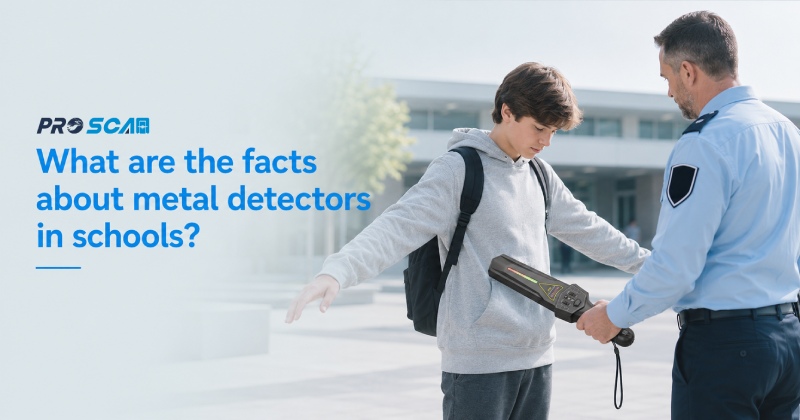
1. Metal detectors do not replace other security measures
A foundational reality of campus safety is that a metal detector in school facilities is merely one component of a multi-layered security ecosystem. Walk-through gates and handheld wands cannot substitute for comprehensive safety programs, student-support counseling, emergency response training, visitor management systems, or secure perimeter fencing.
Security experts emphasize that detection hardware must work in tandem with active supervision, well-trained campus police or security officers, and open communication channels between students and administration to create a truly secure school culture.
2. Detection capability depends on the equipment and settings
The physical performance of security screening hardware varies significantly based on manufacturing quality, sensor architecture, and sensitivity calibration. Advanced multi-zone walk-through detectors manufactured by ProScan Global incorporate sophisticated digital signal processing that accurately locates metallic objects across vertical zones.
However, if a school operates low-quality or poorly calibrated equipment, or sets sensitivity thresholds too low to avoid false alarms, the system will fail to detect miniature weapons or component parts. Proper initial commissioning and ongoing calibration are essential to ensure the technology performs to its maximum potential.
3. Screening procedures influence real-world effectiveness
Even the most advanced metal detector will fail to maintain security if operational protocols are flawed. Real-world effectiveness is heavily dictated by how security personnel manage the checkpoint.
Factors such as officer attentiveness during peak morning rushes, adherence to secondary wanding procedures when an alarm sounds, and the systematic handling of flagged individuals determine whether prohibited items are successfully intercepted. Ongoing staff training and standardized operating procedures are vital to translating technological capability into practical campus safety.
4. Different schools require different security configurations
There is no universal security template that fits every educational institution. A sprawling suburban high school with multiple open-campus buildings faces vastly different logistical challenges than a single-building urban secondary school or a combined middle-and-high-school complex.
Evaluating facts about metal detectors in schools underscores the necessity of customized security design. Administrators must analyze student population density, building layout, architectural entry points, and local risk assessments to select the appropriate combination of walk-through portals, handheld wands, and auxiliary screening tools provided by experienced manufacturers like ProScan.
How to choose a metal detector for a school security project
Selecting the ideal security screening system for an educational institution requires a systematic evaluation of architectural constraints, risk profiles, student population dynamics, and technological specifications. Choosing the right metal detector in school projects ensures long-term reliability and seamless integration.
Investing in school security infrastructure is a vital administrative decision that directly affects daily operations and campus safety. School boards and procurement managers cannot rely on guesswork; they must follow a structured selection process.
When evaluating equipment, decision-makers must consider the unique environment of an educational campus-where high throughput, durability, and user-friendly operation are paramount. ProScan Global works closely with educational institutions worldwide to provide customized guidance, ensuring that every deployment matches the specific structural and security requirements of the facility.
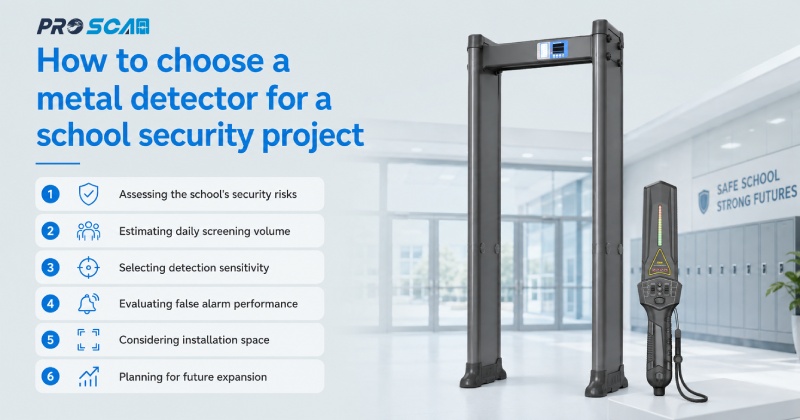
1. Assessing the school’s security risks
Every educational facility possesses a unique threat profile dictated by its location, open versus closed campus architecture, historical incident data, and local community safety standards.
Before selecting security hardware, administrators must conduct a comprehensive threat assessment to determine whether the institution requires standard perimeter deterrence or high-security access control. Understanding these vulnerabilities helps school officials decide where checkpoints should be established and what level of detection sensitivity is required to protect students and staff effectively.
2. Estimating daily screening volume
The logistical heartbeat of any school security checkpoint is student volume. High schools and large educational complexes often face massive arrivals where hundreds or thousands of students attempt to enter within a compressed 20-minute window.
Estimating daily screening volume ensures that selected equipment can process crowds rapidly without generating dangerous bottlenecks. Utilizing high-throughput walk-through metal detectors equipped with multi-zone LED indicators allows security teams to manage peak traffic seamlessly while maintaining strict screening standards.
3. Selecting detection sensitivity
Detection sensitivity determines the system’s ability to identify concealed weapons while filtering out harmless personal belongings. Schools require balanced sensitivity calibration: high enough to detect miniature blades or prohibited metallic components, yet stable enough to ignore everyday items like keys, binders, or belt buckles.
Selecting equipment with adjustable sensitivity levels empowers school security personnel to adapt the system to changing threat levels or specific campus event requirements without increasing false alarm rates.
4. Evaluating false alarm performance
Nuisance alarms disrupt the flow of student entry and cause unnecessary friction at school gates. When evaluating potential security hardware, procurement teams must analyze the system’s resistance to environmental interference-such as nearby electrical wiring, structural steel, or radio communications.
Advanced walk-through gates feature sophisticated digital signal processing and pulse-induction stability that reject ambient electrical noise, ensuring that every alarm represents a genuine security concern and building trust among students and parents.
5. Considering installation space
Physical spatial constraints often dictate the type of security equipment a school can deploy. Entrances vary widely, ranging from spacious modern foyers to narrow historic doorways. Administrators must evaluate corridor dimensions, electrical power access, and environmental conditions (such as indoor versus outdoor vestibules) when planning an installation.
Proper spacing-maintaining safe clearances from walls, doors, and nearby X-ray or electronic equipment-ensures that the metal detector operates at peak calibration accuracy without interference.
6. Planning for future expansion
A successful security investment must anticipate future institutional needs. Educational facilities expand, student enrollments fluctuate, and safety protocols evolve over time. When selecting security hardware, schools should prioritize scalable solutions that support system networking, data integration, and centralized management.
Common challenges when using metal detectors in schools
Integrating physical security screening into educational environments presents unique operational, logistical, and psychological challenges that administrators must proactively manage to ensure program success.
While deploying a metal detector in school checkpoints offers undeniable safety benefits, school officials frequently encounter hurdles during implementation. One primary challenge is managing student throughput during morning peak hours; if a screening checkpoint causes excessive delays, it can disrupt class schedules and create frustration among students and parents.
Additionally, educational institutions must navigate the psychological impact of visible security measures, balancing the need for protection with maintaining an open, welcoming academic atmosphere.
Operational challenges also include staff training and consistency. Security personnel or designated staff members must be thoroughly trained to operate walk-through portals and handheld wands correctly, manage alarms professionally, and follow standardized protocols during secondary inspections.
Environmental factors, such as electromagnetic interference from nearby school electronics or structural metal, can also impact equipment stability if not properly calibrated during installation. By partnering with experienced manufacturers like ProScan Global, educational administrators receive comprehensive technical guidance, professional training resources, and robust equipment design that minimizes these operational friction points.
Why does ProScan Global provide security solutions for schools?
ProScan Global delivers trusted, intelligent security inspection solutions tailored to educational institutions by combining advanced electromagnetic engineering, rigorous quality manufacturing, and comprehensive, customizable product ecosystems.
Educational facilities require security partners who understand the unique sensitivities and operational demands of academic environments. ProScan Global stands out as a premier global manufacturer dedicated to protecting schools, transit hubs, and public spaces through innovation and reliability.
Backed by advanced manufacturing bases and extensive research infrastructure, our comprehensive product portfolio-including multi-zone walk-through metal detectors, precision handheld metal detectors, shoe scanners, and Under Vehicle Surveillance Systems (UVSS)-provides schools with a complete, one-stop security solution.
Choosing ProScan Global as a security partner offers educational institutions distinct advantages. Every security gate and scanning device undergoes rigorous quality control testing to ensure strict compliance with international electrical safety, electromagnetic compatibility, and human safety standards-guaranteeing that emissions are entirely safe for all students, staff, and visitors, including pregnant individuals or pacemaker wearers.
Furthermore, our engineering teams provide tailored OEM/ODM support, helping school districts configure systems that match their exact architectural layouts, throughput demands, and institutional budgets.
In summary, deciding whether a metal detector in school facilities is a worthwhile investment involves weighing empirical safety outcomes against operational realities and community values. Throughout this guide, we have explored how modern walk-through and handheld detection systems function, where they are deployed across high school campuses, and what objective facts govern their real-world effectiveness.