
Portable audio gear has become ubiquitous, leading security personnel and visitors alike to question how common consumer electronics interact with portal screening technology. Specifically, understanding the behavior of a walking through metal detector with headphones is essential for minimizing false alarms, streamlining queue management, and preventing unnecessary secondary inspections. This guide provides an in-depth analysis of how walk-through portals interact with audio electronics, examining physical construction variables, detection mechanics, and institutional screening protocols to ensure optimal checkpoint efficiency.

Walking through metal detector with headphones set off security screening?
The short answer is yes, under many standard operating conditions, headphones frequently cause security gates to sound an alert.
However, whether a specific pair of headphones will set off the alarm depends entirely on a combination of factors, including the size and volume of the metal components inside the drivers, the presence of internal wiring, structural metallic headbands, and the sensitivity calibration of the screening portal itself.
In high-security environments where walk-through metal detectors are calibrated to maximum sensitivity to intercept tiny contraband items, even miniature electronics containing micro-magnets or copper voice coils can disrupt the local electromagnetic field. Conversely, in commercial or institutional settings where sensitivity thresholds are adjusted to ignore small personal belongings such as keys or jewelry, smaller audio accessories might pass through without triggering an alert.
Security personnel must therefore understand that headphones are neither universally ignored nor guaranteed alarms; their interaction with the system is governed by predictable physical properties of conductivity and electromagnetic induction. Understanding this dynamic allows checkpoint operators to evaluate whether an individual requires secondary screening or if operational adjustments can be made to improve overall lane throughput.

Can you walk through a metal detector with headphones?
In general, people can be required to pass through a walk-through metal detector while carrying headphones, but whether the headphones contribute to an alarm depends on their metallic components, size, orientation, and the detector’s sensitivity settings.
Navigating access control checkpoints with personal electronics often creates confusion for individuals who are uncertain whether they must remove their accessories prior to screening. From a procedural standpoint, security protocols generally permit individuals to carry or wear personal items through a walk-through portal, but the built-in detection technology will react to any conductive material that crosses its active electromagnetic field.
Because headphones contain various metallic elements-ranging from neodymium magnets and copper voice coils to aluminum speaker frames and steel headband reinforcement-they interact directly with the alternating magnetic fields generated by the security gate.
Whether a traveler successfully clears the portal while wearing their audio gear depends heavily on the device’s physical composition. Large over-ear studio monitors packed with heavy magnetic drivers and metal headbands will almost certainly trigger an alarm, whereas lightweight plastic earbuds with minimal internal metal mass might occasionally slip through under lower sensitivity configurations.
However, standard security best practices strongly recommend placing all electronic devices, including headphones, into inspection trays alongside mobile phones and keys before stepping through the portal. This proactive measure prevents nuisance alarms, eliminates the need for intrusive secondary pat-downs, and maintains high-speed passenger flow through busy checkpoints.

1. Why can headphones contain detectable metal?
To understand why audio accessories frequently trigger security alerts, one must examine the internal engineering and material composition of modern acoustic devices. Unlike simple plastic casings, functional headphones rely on complex electromechanical components to convert electrical audio signals into sound waves.
At the core of almost every speaker driver is a permanent magnet-frequently composed of neodymium, iron, or boron-which generates a robust magnetic field necessary to drive the speaker cone.
In addition to these powerful magnets, headphones incorporate substantial amounts of copper or aluminum wiring within their voice coils, miniature circuit boards in wireless models, steel reinforcement bands in the headband architecture, and metal mesh grilles over the ear cups.
Because these conductive metals and magnetic materials readily absorb and disrupt external electromagnetic fields, any walk-through metal detector tuned to sense metallic presence will register the density and mass of these components, resulting in a positive security alarm.
2. Different types of headphones and their construction
The consumer audio market features a vast array of designs, ranging from massive over-ear noise-canceling headphones to ultra-compact wireless earbuds and traditional wired models. Each design category presents a distinct metal profile during security screening:
- Over-ear and on-ear headphones: These models feature large acoustic drivers, thick magnetic assemblies, and rigid metal support structures within the headband, making them highly detectable across virtually all security portal settings.
- Wired in-ear monitors (earbuds): While smaller in physical size, wired earbuds contain copper wire bundles running along the cable length and tiny magnetic drivers in each earbud housing, which can still register on high-sensitivity detectors.
- True wireless earbuds: Modern bluetooth earbuds pack miniature lithium-ion batteries, delicate circuit boards, charging contacts, and compact magnetic drivers into a small space, presenting localized high-density metallic components that can trigger targeted detection zones.
3. Why one headphone may trigger an alarm while another does not?
Checkpoint operators frequently observe instances where one individual passes through a security gate wearing headphones without incident, while another person carrying a seemingly similar device triggers an immediate alarm. This variance is governed by several operational and physical variables:
- Total metallic mass and density: A premium over-ear headphone containing heavy-duty steel hinges and large neodymium magnets possesses significantly higher conductive mass than a minimalist plastic earbud.
- Device orientation: The physical angle at which the headphones pass through the portal’s electromagnetic field affects how much inductive disruption they cause.
- Portal sensitivity calibration: If a walk-through gate is calibrated for a high-security environment (such as a prison or government courthouse), it will detect microscopic amounts of metal. If the same gate is configured for a commercial building with higher tolerance for personal items, smaller audio devices may go unnoticed.
- Environmental electromagnetic interference (EMI): Nearby electronic equipment can temporarily influence baseline signal processing, though high-performance gates utilize advanced digital filtering to maintain consistent performance.
Read more: What do hand held metal detectors detect?
How do walk-through metal detectors detect headphones?
When a visitor passes through an inspection portal wearing or carrying portable audio equipment, the interaction is governed entirely by foundational electromagnetic principles.
To understand how advanced systems evaluate personal accessories, security managers examine the core mechanisms that transform invisible magnetic fields into actionable security intelligence. At ProScan Global, our engineering philosophy centers on delivering ultra-sensitive, stable, and multi-dimensional screening performance across all walk-through metal detectors.
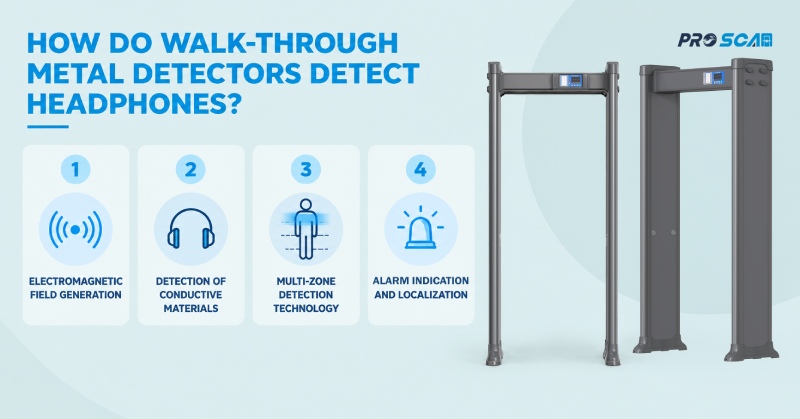
1. Electromagnetic field generation
The operational foundation of any walk-through security portal is electromagnetic induction. Transmitter and receiver coils embedded within the vertical side panels of the gate emit stable, alternating electromagnetic fields, creating a uniform detection zone across the passageway.
When a subject carrying a metallic item steps into this corridor, the primary magnetic field induces tiny electrical currents-known as eddy currents-within the conductive metal components of the item. These induced currents generate a secondary, opposing magnetic field that subtly distorts the original baseline field established by the gate.
2. Detection of conductive materials
Headphones, by their very nature, are packed with conductive metals and magnetic components designed to process electrical audio signals. When these materials traverse the active electromagnetic field of a security portal, they absorb and alter the magnetic flux.
Traditional walk-through gates function as metal presence detectors, responding to changes in signal amplitude. Because audio gear contains copper voice coils, aluminum frames, and permanent magnets, it presents a substantial conductive mass that disrupts the electromagnetic balance, prompting the receiving coils to register an anomaly.
3. Multi-zone detection technology
Modern high-performance walk-through metal detectors-such as those engineered within ProScan Global’s advanced product ecosystem-utilize zoned detection architecture. Instead of treating the entire passageway as a single detection block, the internal coils are partitioned into multiple independent horizontal zones.
This zoning technology enables the system to pinpoint the vertical height of a metallic object on a person’s body. If a user wears over-ear headphones, the upper detection zones register the anomaly immediately, displaying the precise location on the pillar’s LED indicator lights to guide security personnel.
4. Alarm indication and localization
When the receiving circuitry detects a disruption that exceeds the pre-configured threshold, the system triggers an immediate audiovisual alarm. The integrated digital control box processes the incoming electrical signal and activates specific LED light bars corresponding to the height and side of the detected object.
This rapid localization ensures that security staff can instantly distinguish whether an alert corresponds to head-level accessories like headphones or lower-body items, streamlining the decision-making process during secondary inspections. (1)
Read more: What do walk through metal detectors detect?
Can metal detectors distinguish headphones from other metal objects?
A conventional walk-through metal detector primarily responds to the electromagnetic characteristics of metallic objects. It does not normally identify a specific consumer product such as headphones solely from the alarm signal.
When individuals approach security screening checkpoints wearing personal audio gear, security managers and system operators frequently wonder whether advanced inspection portals possess the capability to recognize specific consumer electronics.
In standard operational deployment, a walking through metal detector with headphones interacts with the gate’s magnetic field through basic electromagnetic induction principles. Traditional walk-through gates and high-performance inspection portals function primarily as metal presence and density detectors rather than item-classification scanners.
When audio accessories pass through the active doorway, the unit evaluates the physical mass, electrical conductivity, and magnetic permeability of the metallic components inside the device-such as copper voice coils or neodymium driver magnets. However, the internal digital signal processing unit registers these characteristics as generalized metallic signatures rather than labeling the item as a branded electronic accessory.
While advanced multi-zone systems can pinpoint the exact vertical elevation of the signal-instantly alerting security staff that a metal mass is located at head level-the equipment cannot inherently differentiate between a pair of studio headphones, a metal-framed pair of eyeglasses, a metallic hair clip, or a concealed metallic weapon of similar mass.
Because conventional walk-through architecture analyzes signal amplitude and phase displacement across localized zones, security personnel must rely on secondary visual inspection or manual screening tools-such as ProScan Global’s precision handheld metal detectors-to verify the exact nature of the triggered item. This operational distinction highlights why clear preparation protocols, such as placing personal electronics into inspection trays, remain essential for maintaining checkpoint efficiency.
Why ProScan Global provides walk-through metal detection solutions
As global security challenges evolve across institutional, commercial, and public environments, deploying robust, reliable, and intelligent inspection hardware is more critical than ever. ProScan stands at the forefront of the security inspection industry, combining over a decade of dedicated research, development, and manufacturing excellence to deliver state-of-the-art security ecosystems.
Our comprehensive product portfolio encompasses industry-leading walk-through metal detectors, high-precision handheld metal detectors, advanced shoe scanners, and comprehensive Under Vehicle Surveillance Systems (UVSS), serving clients across more than 100 countries worldwide.
Choosing ProScan Global as an equipment manufacturer or OEM/ODM partner provides distinct operational advantages. Every walk-through metal detector produced within our advanced manufacturing facilities undergoes rigorous quality control testing to ensure strict compliance with international electrical safety, electromagnetic compatibility, and human safety standards.
Utilizing weak magnetic field technology and advanced digital filtering, our systems deliver exceptional detection sensitivity while remaining entirely safe for pacemaker wearers and pregnant individuals. By integrating multi-zone localization, intelligent false alarm suppression, and robust networking capabilities, ProScan Global empowers security directors worldwide to optimize checkpoint throughput, minimize nuisance alerts caused by personal accessories, and build impenetrable defense perimeters.
In summary, navigating modern security checkpoints while managing personal electronics requires a clear understanding of how electromagnetic technology interacts with everyday consumer items. Throughout this comprehensive analysis, we have examined the physical mechanics of a walking through metal detector with headphones, exploring why acoustic devices contain detectable metal components, how walk-through portals utilize multi-zone induction sensing, and why traditional gates measure generalized conductivity rather than identifying specific product types.