Frontline security operators to a fundamental operational question: what do hand held metal detectors detect? Knowing precisely what these portable instruments can identify is essential for optimizing security workflows across high-traffic facilities such as transport hubs, schools, correctional facilities, and entertainment arenas. In this comprehensive guide, we examine the underlying physics, metallic classifications, operational mechanics, and functional limits of portable inspection wands to help facility managers maximize security effectiveness.
What do hand held metal detectors detect?
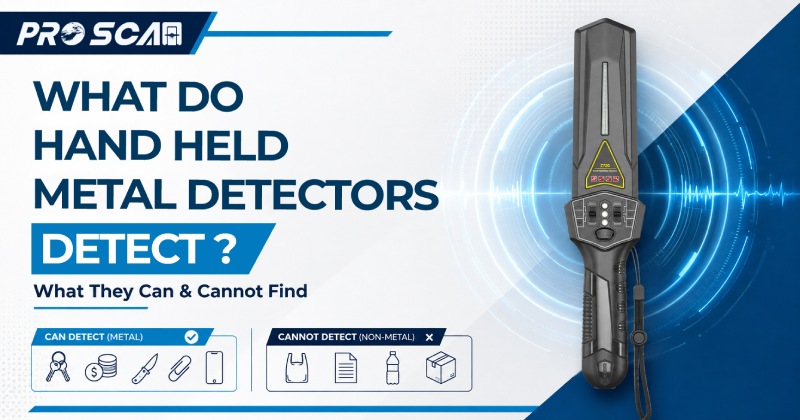
Handheld metal detectors detect both ferrous and non-ferrous metallic objects-including weapons, tools, components, and electronic devices-by generating an electromagnetic field that induces eddy currents in conductive materials, triggering immediate audible, visual, or vibratory alerts when an anomaly is encountered.
When evaluating what hand held metal detectors detect, security personnel must recognize that these portable devices are engineered to locate virtually any conductive mass brought within range of their transmission coil.
Whether assessing what can a hand held metal detector detect during a targeted secondary pat-down or investigating what metal detectors check for at a secure access control checkpoint, the fundamental function remains consistent. Security operators frequently query metal detectors what they detect when calibrating their wands for specific threat profiles, ensuring that prohibited items ranging from concealed steel blades to small electronic components do not bypass inspection.
1. Common metallic objects detected
Professional security wands are primarily deployed to detect prohibited items and weapons, but their sensitivity allows them to locate a wide array of metallic objects:
- Weapons and contraband: Firearms, knives, stilettos, box cutters, razor blades, tactical batons, and improvised metallic weapons.
- Personal belongings and everyday items: Keys, heavy jewelry, coins, belt buckles, foil-lined packaging, and metal zippers.
- Electronic hardware: Smartphones, tablets, circuit boards, unauthorized recording devices, and lithium-ion batteries.

2. Ferrous vs non-ferrous metals
The detection capabilities of a handheld wand encompass both major categories of metals:
- Ferrous metals: Iron, steel, and alloys containing iron. These materials possess high magnetic permeability and are exceptionally easy to detect because they strongly influence the detector’s primary magnetic field.
- Non-ferrous metals: Aluminum, copper, brass, lead, zinc, gold, and silver. While non-ferrous metals are non-magnetic, they are highly electrically conductive. When swept by a wand, they generate powerful eddy currents that disrupt the electromagnetic field, producing a reliable alarm. (1)
3. Factors that influence detection capability
A wand’s ability to successfully identify an object is governed by several variables, including the physical mass of the metal, its alloy composition, the distance between the wand surface and the object, and the operator’s sweep speed. Larger metallic surfaces create a more pronounced disruption in the induced electromagnetic field, whereas extremely small or fine-gauge wires require the wand to be held much closer and moved at a slower, more deliberate pace.
4. Detection limitations
While highly sensitive, handheld detectors are not omniscient. Their performance can be impacted by heavy background electromagnetic interference (EMI) from nearby electrical infrastructure or X-ray machinery. Furthermore, because they are designed to detect conductivity and magnetic permeability, they cannot differentiate between a harmless metal belt buckle and a dangerous concealed weapon without manual secondary verification by the operator.
How handheld metal detectors identify metal objects?
Handheld metal detectors identify metal objects by utilizing electromagnetic induction, where an alternating current in the transmission coil creates a magnetic field, and any entering conductive object disrupts this field, causing receiver circuits to signal an alarm.
To fully understand how handheld metal detectors identify metal objects, one must look inside the structural engineering of the wand itself. Portable inspection wands operate on the exact same fundamental physical principles as large walk-through security gates, yet are scaled for close-range, high-mobility tactical applications.
1. Electromagnetic field generation
Inside the head of a handheld metal detector, a primary oscillator circuit drives a transmission coil with an alternating current. This current generates an invisible, stable alternating electromagnetic field that projects outward from the scanning surface of the wand. When the wand is swept smoothly over an individual’s body, this magnetic field envelops any clothing, bags, or items being worn.
2. Signal disruption caused by metal
When a conductive or magnetizable object-such as a steel blade or aluminum housing-enters the magnetic field, two things happen: magnetic flux lines concentrate within ferrous materials, and electrical currents known as eddy currents are induced inside conductive non-ferrous metals. These eddy currents generate their own secondary opposing magnetic fields, which distort the primary field and alter the electrical properties of the wand’s resonant tuning circuit.
3. Alarm notification systems
The moment the receiver coil detects this electromagnetic shift, the internal signal processing unit instantly converts the data into an alert. Modern professional detectors-such as those engineered by ProScan Global-provide multi-modal notification options, including bright red LED visual indicators, high-output speakers for audible tones, and silent vibration modes for discreet operational checks.
4. Sensitivity adjustment for different screening scenarios
Because screening environments vary widely, handheld detectors feature adjustable sensitivity controls (ranging from low to high presets). Security personnel can adjust these thresholds to filter out minor background artifacts or environmental noise while maintaining high sensitivity for critical threat detection during secondary inspections.
Factors that affect detection performance
While the core underlying technology of electromagnetic induction remains consistent across professional inspection equipment, a handheld unit’s real-world effectiveness is governed by several external and physical variables. When evaluating what do handheld metal detectors detect in high-pressure operational environments, security officers must recognize how physical composition, object geometry, and environmental conditions alter the responsiveness of the device.
1. Metal composition

The material makeup of an object directly dictates how strongly it interacts with the detector’s electromagnetic field. Ferrous metals-such as iron and carbon steels-possess high magnetic permeability, meaning they concentrate magnetic flux lines and trigger very strong, immediate response signals.
Non-ferrous metals like aluminum, copper, brass, and lead lack magnetic permeability but are highly electrically conductive. When the wand passes over them, they generate powerful eddy currents that disrupt the field. However, highly resistive or trace amounts of metal require closer proximity and slower sweep speeds to register reliably.
2. Object size and shape
The physical mass and surface area of the item play a critical role in detection outcomes. A large steel hunting knife or a firearm possesses substantial mass, creating an easily detectable disruption from a greater distance. Conversely, small, thin objects-such as a tiny foil wrapper, a small screw, or a fine-gauge wire-present a minimal conductive surface area.
The orientation of the object also matters; a flat metallic coin or blade lying parallel to the scanning coil will trigger a much stronger response than when oriented vertically or edge-on relative to the wand face.
3. Detection distance
Proximity is vital for precise secondary screening. Handheld wands are engineered to project a focused, close-range electromagnetic field designed for targeted pat-downs. If the operator holds the wand too far away from the subject’s body, even a significant metallic threat can fall outside the effective magnetic threshold.
Maintaining a consistent scanning distance-typically between 1 to 2 inches (about 2,5 to 5 cm) from the surface-ensures that the transmission field fully envelops any concealed items.
4. Environmental interference
External variables can severely distort detection accuracy. High concentrations of ambient electromagnetic interference (EMI) originating from nearby heavy electrical equipment, power distribution rooms, fluorescent lighting grids, or large architectural steel structures can introduce background noise into the wand’s receiver circuit.
Operating too close to these sources can cause erratic behavior or false alarms, requiring security personnel to calibrate sensitivity settings or relocate screening zones accordingly.
Read more: Do handheld metal detectors affect people with implanted medical devices?
What handheld metal detectors cannot detect?
Handheld metal detectors cannot detect non-metallic materials such as plastics, ceramics, glass, liquids, and organic substances, as their operational design relies strictly on electromagnetic induction and conductivity.
While portable inspection wands are exceptionally effective tools for intercepting concealed weapons and metallic contraband, security professionals must maintain a clear understanding of their physical boundaries. Knowing what handheld metal detectors cannot detect prevents false security assumptions at access control checkpoints, reinforcing the necessity for comprehensive screening protocols.
1. Non-metallic materials
Because the core mechanism of a metal detector relies on generating an electromagnetic field that reacts with conductive elements or magnetic materials, any item lacking electrical conductivity or magnetic permeability remains entirely transparent to the sensor coil.
2. Plastic, ceramic, and composite objects
Contraband crafted from high-impact polymers, advanced ceramics, or non-conductive composite materials-such as ceramic blades, plastic tactical items, or certain improvised components-will pass directly through a handheld metal detector’s scanning field without generating any disturbance or triggering an alarm.

3. Liquids and organic materials
Liquids, gels, powders, and organic substances (including biological contraband, food items, or paper goods) possess no significant metallic conductivity. As a result, a handheld wand cannot identify chemical compositions, explosives, or liquid threats on its own, making specialized auxiliary screening technologies indispensable.
4. Why layered security systems are important
These inherent physical limitations underscore why no single device can secure a modern facility on its own. Absolute perimeter defense requires a multi-layered security ecosystem-such as the comprehensive intelligent inspection solutions provided by ProScan Global.
By combining walk-through metal detectors, handheld inspection wands, advanced shoe scanners, and Under Vehicle Surveillance Systems (UVSS) with X-ray baggage inspection and trace detection equipment, facilities can eliminate blind spots and ensure total threat mitigation.
Read more: Top 3 best handheld metal detector.
Why global organizations choose ProScan Global
When institutions demand uncompromised perimeter defense and absolute operational reliability, they partner with ProScan. With over 14 years of manufacturing excellence in intelligent security inspection solutions, we have earned the trust of global clients across high-risk sectors, from international transit hubs to major educational campuses and entertainment arenas.
Our success stems from our comprehensive, factory-direct approach to security engineering:
- Advanced manufacturing capabilities: Operating from our extensive, modern production facility, we utilize automated manufacturing processes to ensure that every walk-through metal detector, handheld scanner, shoe scanner, and Under Vehicle Surveillance System (UVSS) meets rigorous quality control standards, ensuring exact coil calibration and structural durability.
- OEM and ODM expertise: We understand that every facility possesses unique operational detection requirements. Our engineering team specializes in customizing sensitivity profiles, detection thresholds, and multi-modal alert configurations to match your exact compliance needs.
- Comprehensive ecosystem: ProScan Global provides a complete product portfolio, allowing organizations to build a fully integrated, multi-layered security architecture from a single trusted manufacturer.
As we have explored throughout this guide, mastering what do hand held metal detectors detect requires evaluating the underlying physics of electromagnetic induction, ferrous and non-ferrous material responses, object sizing, and environmental variables. Whether security personnel are determining what can a hand held metal detector detect during routine secondary checks, identifying what do metal detectors check for at transit gates, or analyzing metal detectors what they detect to optimize checkpoint sensitivity, understanding both the capabilities and limitations of the hardware is essential for professional security management.